1. Introduction
To enhance the development of risk prevention and control capabilities, e-government must address several significant challenges, including an overemphasis on technology at the expense of governance, a focus on information rather than knowledge, and a tendency to prioritise construction over integration (Yang, 2024). In recent years, the rapid advancement of research fields such as public management and information technology, coupled with the vigorous growth of the knowledge economy, has led to increased academic interest in new models and emerging issues related to e-government affairs, including the development of government intelligence (Yigitcanlar et al., 2024). At the same time, based on different research backgrounds, innovative theories about governments have been continuously proposed, and the most representative ones include learning government and smart government (Hujran et al., 2023). Driven by globalisation of knowledge, the wave of integrating informatisation, networking, intelligence and globalisation is spreading to various fields such as politics, economics, culture, security and education at the global level (Lind & Ramondo, 2024). Human society is transitioning into a new phase characterised by a knowledge economy. The development of this knowledge economy relies on knowledge-based elements, which primarily exhibit key characteristics such as the economic value of knowledge, the intangibility of assets, sustainable development and economic globalisation (Moid et al., 2024). The value derived from knowledge significantly surpasses that of traditional production factors, such as capital and materials (Moid et al., 2024). Based on knowledge management theory, constructing an e-government system architecture from the viewpoint of top-level design and other relevant aspects, such as technical infrastructure and legal and regulatory frameworks, will effectively integrate government resources, optimise government services, enhance government efficiency and facilitate government development (Armenia et al., 2023). Therefore, the study of knowledge-based government is motivated by a profound social, economic, and political context.
Currently, we are witnessing a critical period of accelerated transformation towards knowledge-based governments. In the field of public administration, research on knowledge-based governments is undergoing rapid development (Wang et al., 2023). While knowledge management practices exist, they often play a concealed role within governmental operations, furthermore, the influence of knowledge elements on government management requires further exploration and improvement (Wang et al., 2023). Consequently, there is an urgent need for governments to enhance their awareness of knowledge management. The knowledge-based government model first emerged as a comprehensive enhancement to the service-based government paradigm. It was proposed from both external and internal administrative perspectives in response to contemporary social development trends (Schmidthuber & Hilgers, 2021). The integration of knowledge management with e-government will fully unleash the potential of government resources. It facilitates the sharing of governmental knowledge and enhances the accuracy of decision-making in government affairs (Al Sayegh et al., 2023). Furthermore, research on knowledge-based government will foster the innovation of government models in a more comprehensive and scientific manner. The integration and optimisation of government affairs will facilitate the establishment of a collaborative and efficient government system, thereby systematically enhancing various dimensions, including openness, fairness, diversity and public service capability (Coen et al., 2023). Finally, the study of knowledge-based government will deepen the application of knowledge management theory in the field of public management, and the design of a new e-government system based on knowledge management will comprehensively enhance government capabilities in the fields of infrastructure, internal management, government openness, knowledge sharing and intelligent decision-making (An et al., 2022).
Amid accelerating globalisation and rapid advancements in information technology, Customs serves as a crucial government gateway for ensuring national economic security (Asia Pacific Economic Cooperation, 2024). In the age of big data, the acquisition and processing capabilities of massive amounts of information have become a key way for Customs to enhance business efficiency (Zheng et al., 2025). The construction and optimisation of the customs knowledge system represent a tangible manifestation of customs authorities seizing the opportunities brought about by the rise of the knowledge economy (Tian et al., 2024). The construction of knowledge-based Customs can help solve the business challenges of customs officers, open customs clearance supervision blockages, integrate customs business resources and then promote the construction of smart Customs (S. Kim et al., 2023). The theme for the World Customs Organization (WCO) International Customs Day in 2023 was ‘Nurturing the next generation: promoting a culture of knowledge-sharing and professional pride in Customs’ (WCO, 2023). This theme offered a more advanced framework for the exchange of knowledge and experiences among customs authorities. Under this collaborative framework, customs agencies in various economies can thoroughly investigate the avenues and strategies for sharing customs-related experiences and knowledge. The construction of knowledge-based government should adhere to fundamental principles of science, rationality and efficiency (Armenia et al., 2023). It is essential to address common issues such as low efficiency, redundant construction and resource wastage in the process of developing knowledge-based Customs (Tian et al., 2024).
The primary objective of this study is to address the critical challenges in modern customs administration by developing a systematic and scientifically grounded evaluation framework for knowledge management systems within customs agencies. In the context of rapid technological advancement and growing complexities in global trade, customs authorities are increasingly required to enhance their regulatory efficiency, ensure trade security and facilitate economic development through intelligent decision-making and resource optimisation. However, existing practices often reveal significant gaps, including a disproportionate focus on technological infrastructure rather than governance mechanisms, fragmented knowledge resources and insufficient integration of knowledge into operational and strategic processes.
To tackle these issues, this study employs the Analytical Hierarchy Process (AHP) method to construct a comprehensive evaluation index system tailored to the unique needs of customs knowledge management. The specific objectives of this study are to:
-
identify and define key dimensions (first-level indicators) and sub-dimensions (second-level indicators) essential for evaluating the effectiveness of knowledge management in customs operations
-
determine the relative weights of these indicators through the AHP approach, ensuring a scientifically valid and hierarchical structure that reflects practical priorities
-
provide evidence-based recommendations for optimising knowledge resource allocation, improving intelligent decision-making capabilities and enhancing the overall efficiency of customs supervision and services
-
contribute theoretically and practically to the emerging field of knowledge-based government, particularly in the context of smart customs development.
Following this introduction, Section 2 of this paper systematically examines knowledge-based smart customs construction, with a specific focus on its application in the public sector, and reviews its current state. Section 3 introduces the concept and principles of the AHP and establishes a structured framework for evaluating customs knowledge management. Section 4 presents the process of determining first-level indicators, designing and screening secondary indicators, and constructing a hierarchical model of the index system. It further includes the calculation of indicator weights, along with consistency tests and prioritisation of indicators. Section 5 summarises the main findings of the study, puts forward practical recommendations for optimising the customs knowledge system, identifies theoretical contributions, reflects on research limitations and proposes directions for future research.
Through this structured approach, the study aims to provide a robust framework that supports customs agencies in transitioning towards knowledge-based, intelligent and efficient operational models.
2. Literature review
2.1. Knowledge management theory
The development of human civilisation has been accompanied by the exploration, understanding and management of knowledge. However, in the past 40 years, the study of knowledge management remains an emerging discipline in the field of management (Ting, 2023). Knowledge management theory is an emerging research field that has developed alongside the rise of the knowledge economy. It focuses on the effective management and utilisation of knowledge resources to enhance the competitiveness and innovative capabilities of organisations (Jabeen & Al Dari, 2020).
Studies such as those by Fantl (2020) support the foundational role of epistemological thought in knowledge management theory. Scholars like Turulja and colleagues (2021) study the generation and sharing of knowledge from the perspective of the development of the knowledge economy. Knowledge-based theory is not only an information application tool, but also a strategic planning tool (Hughes & Hodgkinson, 2021). It involves various models such as knowledge classification, intellectual capital and social structure. Knowledge management theory is categorised into distinct schools of thought with the main areas of research divided into technical, behavioural and comprehensive. This provides a new direction for the research and practice of knowledge management (Anjaria, 2022). However, development of knowledge management theory has several challenges, including the indistinct boundaries of knowledge management and the conversion of personal knowledge into organisational knowledge. This transformation necessitates addressing issues related to the transition between implicit and explicit knowledge (AhmadYousefi et al., 2020).
Knowledge management theory is a multidimensional and interdisciplinary field of research. It encompasses not only the discovery, organisation, dissemination and utilisation of knowledge but also the strategies for maximising the value of knowledge through both technical and managerial approaches (Alaimo & Kallinikos, 2021). Knowledge management theory is broad and profound, covering many aspects such as the definition, creation, transformation, storage, sharing and organisational learning of knowledge (Nee et al., 2023). Confronted with the challenges posed by the knowledge economy, a deep understanding and application of these theories are essential for enhancing an organisation’s knowledge management capabilities and fostering sustained innovation and development (Restuputri et al., 2024). However, existing research still lacks an in-depth discussion of the rationality and effectiveness of its underlying assumptions and theoretical basis (Silva & Silva, 2023). Consequently, future research should further investigate the theoretical foundations of knowledge management, address existing challenges, and continuously refine and innovate the strategies and methods employed in practical applications of knowledge management (Kaushal et al., 2024).
2.2. Construction of a knowledge-based smart Customs
In the current global development landscape, the primary objective of customs authorities across various countries is to ensure national and border security. This is achieved through the precise implementation of risk prevention and control measures, the maintenance of national security and the effective utilisation of intelligence (Karklina-Admine et al., 2024). The knowledge economy poses new challenges to customs management, including global integration of modern management awareness and intelligent management of knowledge (Salnikova & Chernova, 2020).
Research on the customs knowledge system encompasses various business domains related to customs supervision. For instance, in adapting to Industry 4.0[1], customs authorities are developing classification frameworks for emerging technologies, such as drones (Yi & Moon, 2019), to enable effective supervision. This approach aims to streamline the selection and management of the product knowledge resources (i.e. the knowledge generated from these tangible, non-theoretical operational processes) that Customs has accumulated through its usual hands-on regulatory activities. In the field of customs risk management, South Korean customs authorities exemplify innovative risk management practices by integrating advanced technology and transformative public organisational thinking. They have adopted a digital Customs and risk management framework that promotes free trade and travel while simultaneously preventing the cross-border transportation of dangerous goods and individuals (S.-B. Kim & Kim, 2020). Scholars in this field such as Ylönen and Aven (2023) investigate the integration of intelligence and risk management within the context of Customs and border control from a novel perspective. This perspective is grounded in contemporary scientific understanding of risk and security, as well as research on intelligence, organisational management and social mechanisms, which collectively facilitate this integration of concepts, principles and unified frameworks.
In the realm of customs management theory, Makrusev and others (2018) innovatively propose a government adaptive evolution model along with a specific implementation mechanism. This model is characterised by a continuous feedback loop where operational data (e.g. declarations, inspection results, supply chain information) are constantly analysed to identify risks and inefficiencies. The mechanism involves adaptive decision-making algorithms that dynamically refine inspection targets and resource allocation based on this analysis. This approach transcends the traditional static, integrated management model by enabling a proactive and self-optimising system. Consequently, customs supervision in the context of big data exhibits more systematic coordination and personalised treatment of risks, enhancing overall efficiency and effectiveness. Understanding the dynamics of changing traffic is crucial for customs risk management. Traditionally, customs authorities worldwide have depended on local resources to gather knowledge and identify tax fraud. This reliance can lead to increased illegal trade in countries with weak infrastructure and tax haven status. The assertion that increased illegal trade is a natural consequence reflects an analytical observation of systemic causality, not moral justification. This outcome stems from a logical chain where weak institutional infrastructure reduces detection risks, making such jurisdictions attractive for illicit flows. When combined with the strong economic incentives for evasion in low-risk environments, rational cost–benefit calculations inevitably channel illicit trade towards these vulnerable nodes, creating a predictable systemic outcome. In response to these challenges, Park and others (2022) propose a domain adaptation method, which is a machine learning technique that enables models trained on data from one context (e.g. known fraud patterns in public datasets) to effectively recognise similar patterns in different but related contexts (e.g. local customs environments). This approach facilitates the sharing of transferable knowledge about fraudulent activities while ensuring sensitive local trade information remains protected. Khoshnaw and Karadas (2024) also employ the partial least squares method (PLS-PM or PLS-structural equation modelling (SEM)) to develop structural equation models using customs officers as research samples, investigating complex relationships within this organisational context. As a multivariate statistical technique, it is particularly suitable for analysing intricate causal relationships between latent variables through the collection and analysis of questionnaire data. Khoshnaw and Karadas (2024) find that knowledge sharing plays a significant mediating role between transactional leadership and human capital, as well as between structural capital and relational capital. Among these, transactional leadership is a style that emphasises reciprocal exchange relationships between leaders and followers, where the reward system is directly tied to job performance; structural capital and relational capital are two core components of organisational intellectual capital. Structural capital refers to institutionalised and codified knowledge systems that exist within the organisation independently of individual employees, essentially comprising the hardware, software and procedural frameworks that support organisational operations. Relational capital encompasses the value created through an organisation’s interactions with external stakeholders, such as suppliers and government agencies. In the context of enhancing knowledge management, several scholars such as Castillo and others (2019) have assessed the metacognitive knowledge of students majoring in customs management and its application during internships. The findings indicate that educators bear the responsibility of evaluating students’ metacognitive knowledge to cultivate effective metacognitive skills and to offer necessary learning interventions. This approach aims to enhance customs knowledge management capabilities from the perspective of talent development.
Scholars such as Arazpoor and Meymand (2016) have identified several effective factors that influence the development of knowledge management, including organisational culture, training, strategy, information, organisational infrastructure, top management commitments, organisational conflicts, standardisation, employee performance, communication, budget support and necessity. These factors were examined using Friedman tests based on empirical data from the customs industry. The Friedman test is a non-parametric statistical method used to detect differences in central tendency across three or more related or matched groups. Arazpoor and Meymand (2016) applied this test to rank and compare the perceived importance or effectiveness of various factors influencing knowledge management development, based on survey responses from customs industry participants. To examine the role of customs leadership in fostering the innovative capabilities of customs employees, Salem and others (2023) employed SEM to analyse data collected from employees at Dubai Customs. SEM serves as a comprehensive multivariate statistical technique particularly suitable for testing theoretical models involving multiple dependent and independent variables, including both direct and indirect effects. The findings indicate that both leadership and knowledge management significantly influence employee innovation. Furthermore, trust emerges as a critical factor in the relationship between transformational leadership, knowledge management and employee innovation (Salem et al., 2023).
3. Theoretical basis of the AHP method
3.1. The AHP method
The AHP method is widely used in the study of network system theory and comprehensive evaluation of multi-objective complex problems (Yu & Hong, 2022). This method integrates both quantitative and qualitative analyses, utilising the decision-maker’s theoretical and practical experience to assess the relative importance of the standards that measure goal achievement (Canco et al., 2021). It assigns appropriate weights to each standard within each decision plan, allowing for the calculation of the advantages and disadvantages of various solutions. Among these, network system theory is an interdisciplinary theoretical framework that primarily investigates the structure, behaviour and dynamic mechanisms of systems composed of interconnected components. The application of the AHP in network system theory research is highly relevant, as it helps model complex dependency relationships among multiple elements within a network, supports the evaluation and prioritisation of nodes, paths or subsystems based on criteria such as efficiency, robustness, or risk, and enables the integration of quantitative and qualitative factors like reliability and connectivity into a structured decision-making framework.
The basic steps of the AHP include establishing a hierarchical structure model, constructing a judgement matrix, calculating weight vectors, performing consistency tests, synthesising results and making decisions (Grošelj et al., 2024). This process involves decomposing decision problems into multiple levels, which consist of the target layer, criterion layer and solution layer. Elements within each level are compared to build a judgement matrix, from which the weights of each element are calculated mathematically. Finally, comprehensive sorting is conducted based on these weights to determine the optimal solution.
This comprehensive feature evaluation method involves breaking complex decision-making problems into smaller, more manageable components, which are then evaluated and compared to ultimately form a hierarchical model. This approach has been widely applied across various fields, including, but not limited to, risk management (Zandi et al., 2020), regional governance (Xie et al., 2024) and ecosystem health assessment (Li et al., 2024).
3.2. Principles of the AHP method
The AHP is primarily employed to address complex decision-making challenges that involve multiple goals and criteria, particularly in situations where it is difficult to fully articulate the problem using quantitative data (Zambujal-Oliveira et al., 2025). The essence of AHP lies in its ability to hierarchise complex decision-making issues, thereby streamlining the decision-making process. Through a systematic series of steps, AHP enables the determination of the relative importance of each decision-making factor, ultimately aiding decision-makers in making informed choices. The fundamental principles and steps of AHP are below.
Step 1. Building the hierarchy
-
Target layer: clarify the goal of decision-making
-
Standardised layer: identify the major criteria or factors that affect the achievement of goals
-
Programmatic layer: list alternative decision-making plans or action paths.
Step 2. Scale determination and construction of judgement matrix
Saaty’s 1–9 scale is used to quantify the importance of decision makers to the criteria and the scheme relative to the criteria (Saaty, 1977). The scale ranges from 1 (equally important) to 9 (extremely important), and includes intermediate and reverse values, which are used to express preference relationships of different intensities. When calculating weights, each factor (entry) is compared in pairs (subtraction or reciprocity), and the resulting matrix is called a judgement matrix.
Step 3. Eigenvectors, feature root calculations and weight calculations
The judgement matrix between each criterion layer and the previous layer (target layer or higher criterion layer) is mathematically processed, and its eigenvector is calculated, which is the relative weight of each criterion.
Step 4. Consistency test
This tests whether the matrix reflects consistency. The consistency ratio (CR) is calculated and if it is less than the preset threshold (usually 0.1), the judgement matrix is considered consistent and the weight is acceptable. If the CR is higher than the threshold, the judgement matrix needs to be adjusted until the consistency requirements are met.
Step 5. Comprehensive evaluation and decision-making
The weights of each criterion layer are multiplied by the criterion scores of the scheme layer relative to the criterion and then totalled to calculate the comprehensive score of each scheme. Ultimately, the scheme with the highest score is considered the best choice.
Through this series of steps, the AHP provides a structured framework that enables decision-makers to transform subjective judgements into quantitative numerical values. This approach enhances the transparency and systematic nature of the decision-making process while retaining the flexibility necessary for qualitative analysis. It is particularly suitable for addressing complex issues that involve multiple subjective judgements and stakeholder decision-making.
In summary, the AHP serves as a systematic analysis method that decomposes complex problems into multiple interrelated levels. It employs a comparative approach to ascertain the relative importance of each evaluation index, ultimately resulting in a comprehensive evaluation system.
4. Construction and analysis of a customs knowledge management evaluation index system
This study innovatively applied the AHP method to the index evaluation analysis of the customs knowledge management system. To build a customs knowledge management evaluation index system, the entire evaluation system was divided into three levels: a target layer, a standardised layer and a programmatic layer. These last two layers were further refined into specific quantifiable indicators. The indicators in all layers were selected based on a comprehensive review of existing literature and practical operational requirements in customs knowledge management.
4.1. Identification and definition of first-level indicators in the standardised layer
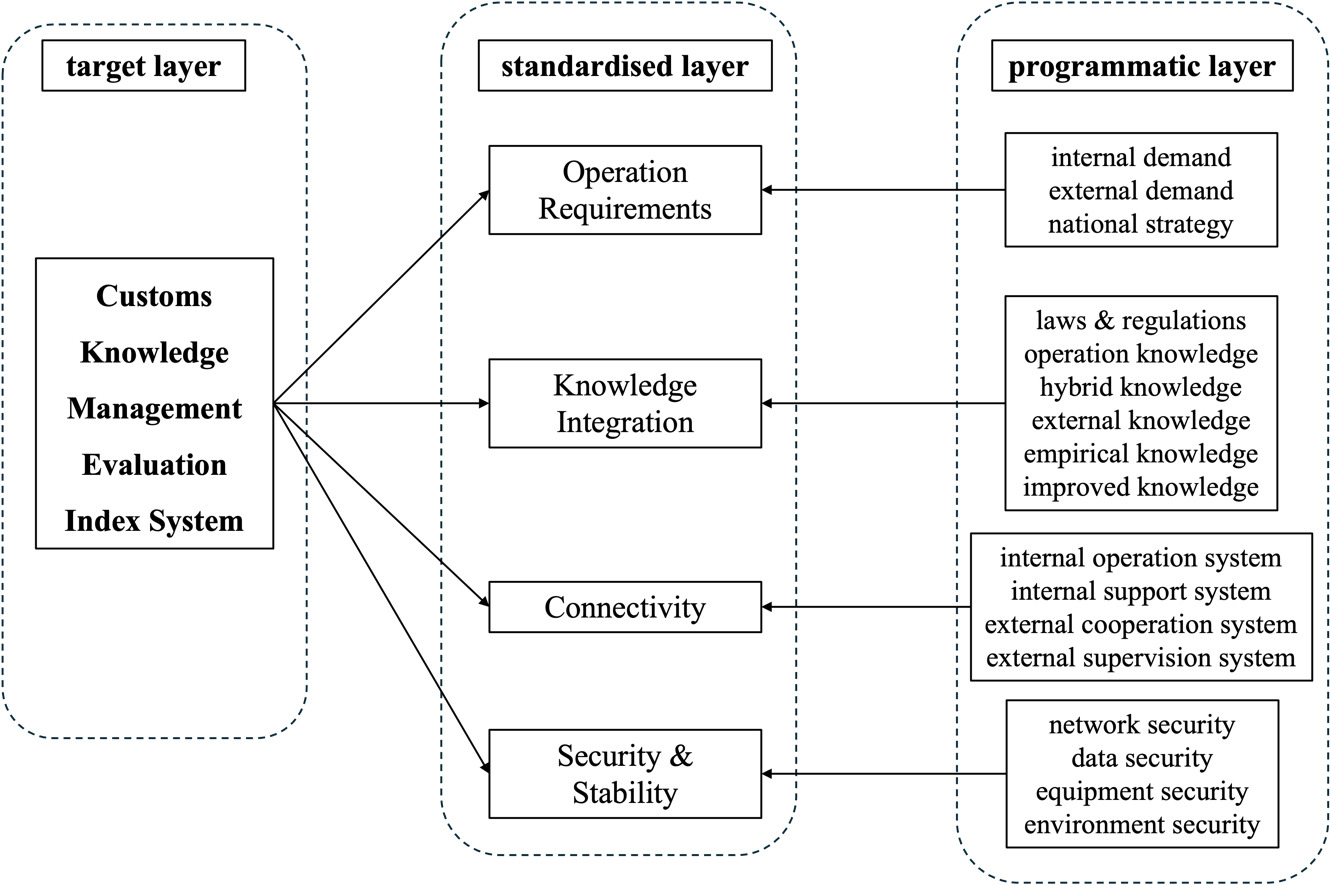
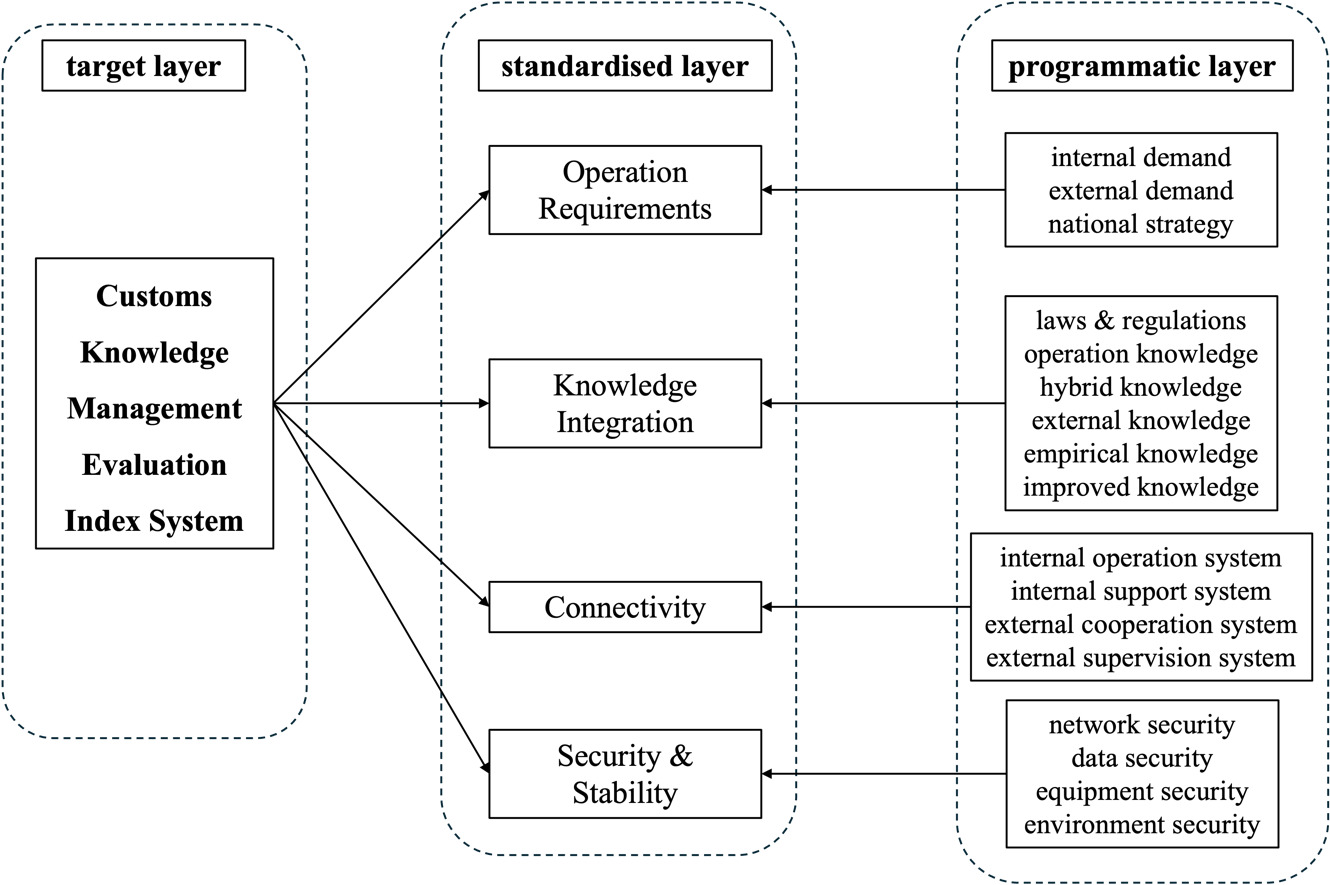
This study identified four first-level indicators for the evaluation of a customs knowledge system: operation requirements, knowledge integration, connectivity, and security and stability, as shown in Figure 1 and outlined below.
These four indicators were derived from widely recognised dimensions of organisational knowledge management and smart government frameworks (e.g. An et al., 2022; Armenia et al., 2023; Ylönen & Aven, 2023). These dimensions align with the core functions and strategic goals of modern customs administrations: enhancing operational efficiency, integrating knowledge resources, strengthening collaboration, and ensuring safe and stable trading environments. This structured and literature-grounded approach ensures that the indicator system is both comprehensive and tailored to the specific context of customs knowledge management. Each indicator is defined below.
Operation requirements
With the expanding development of global economic integration and the continuous enhancement of trade liberalisation, economic and trade activities between countries are becoming increasingly frequent, resulting in a significant increase in customs business volume (Cao & Zheng, 2024). Operation requirements are directly derived from the practical requirements of customs administration. Utilising operation requirements as a primary indicator for evaluating the customs knowledge system can effectively enhance customs work efficiency, foster technical innovation within customs practices, and allow adaptation to the evolving landscape of international economic and trade activities. This approach ensures that the customs knowledge system directly supports the practical needs of customs operations.
Knowledge integration
Customs knowledge integration involves systematically organising and summarising disparate customs-related knowledge, including business practices, laws and regulations, and experiential insights. This process results in a cohesive, unified system that is easy to understand. By utilising the integrated knowledge system, customs staff can enhance their work efficiency and quality. Furthermore, knowledge integration fosters sharing and exchange of information across different departments and positions, delivering comprehensive and accurate data to customs leadership. This, in turn, promotes scientifically rational decision-making and enables the timely and precise identification of potential risks and issues, thereby providing reliable response solutions for customs supervision.
Connectivity
Connectivity refers to the sharing of information and collaborative efforts between customs authorities, businesses, government departments and international organisations, aimed at optimising regulatory processes. Enhanced interconnection facilitates real-time access to import and export information, thereby improving customs clearance efficiency, reducing trade costs and fostering information sharing and cooperation among Customs and other government entities, which collectively helps maintain social order. Furthermore, connectivity can strengthen the international influence of Customs across various economies, establish cooperative relationships among different customs authorities and international organisations, and collaboratively address the various risks and challenges associated with international economic and trade activities.
Security and stability
As the gateway to the supervision of national import and export trade, Customs plays a crucial role in ensuring the security and stability of border trade activities. The maintenance of border security is crucial for deterring criminal acts, fostering social stability and development, ensuring the safety of the nation’s citizens, creating a favourable economic and trade environment, and promoting foreign economic and trade activities.
4.2. Identification of second-level indicators in the programmatic layer
Each second-level indicator was designed based on domain-specific studies and practical customs operational contexts. Four groups of second-level indicators were identified in this study, as outlined below.
Internal demand, external demand and national strategy
Internal and external demand reflect the internal operational challenges and external stakeholder expectations widely discussed in customs modernisation studies (e.g. S.-B. Kim & Kim, 2020; Yi & Moon, 2019). National strategy emphasises alignment with national policies and development agendas (Salnikova & Chernova, 2020).
Laws and regulations, operation knowledge, hybrid knowledge, external knowledge, empirical knowledge and improved knowledge
Categories such as laws and regulations, operational knowledge and empirical knowledge are grounded in knowledge typologies established in public management and customs risk research (e.g. Park et al., 2022; Turulja et al., 2021).
Internal operation system, internal support system, external cooperation system and external supervision system
Indicators including internal operation system and external cooperation system draw from research on interoperability and collaborative governance in digital government (e.g. Coen et al., 2023; Hujran et al., 2023).
Network security, data security, equipment security and environment security
Elements such as network security and data security are informed by studies on cybersecurity and resilient trade infrastructure (e.g. Karklina-Admine et al., 2024; Tian et al., 2024).
4.3. Customs knowledge management evaluation system framework
Based on the application of the Analytic Hierarchy Process (AHP) and the analysis of the aforementioned indicators at each level, we constructed a framework of the customs knowledge management evaluation index system as shown in Figure 1.
4.4. Indicator weight calculation
4.4.1. Indicator consistency test
The judgement matrix (Table 1) reflects pairwise comparisons between Level 1 indicators using Saaty’s 1–9 scale, where values represent relative importance (e.g. 3 = moderate importance). The final weights are derived by calculating the principal eigenvector of this matrix, ensuring a mathematically consistent prioritisation of indicators.
According to step 2 of the AHP method outlined in subsection 3.2, the specific weights of the evaluation indicators for the customs knowledge system represent the relative importance of each indicator within this context. First, the weights of the first-level indicators (operation requirements, knowledge integration, connectivity, and security and stability) were determined, leading to the construction of the judgement matrix shown in Table 1.
Next, the relative weight of each criterion, or eigenvector, was calculated using the geometric mean method, as in Equation 1.
(11/21/31/4211/21/3 3 4 2 311/221)Π→(24 3 1/31/24)4√→(2.21 1.32 0.760.45)normalise→(0.47 0.280.160.09)
Thus, the eigenvector is obtained through this normalisation process.
In Equation 2, A is the judgement matrix, W is the eigenvector of A, and λ is the eigenvalue. It is known that Therefore, in this context,
A∗W=(12341/21231/31/2121/41/31/21)∗(0.470.280.160.09)=(1.871.1050.6370.381)
Therefore, eigenvalue
A consistency test was then conducted. According to Table 2, when the consistency indicator Random Index (RI),
The consistency of the judgement matrix was verified using the CR, as shown in Equation 3. The Consistency Index (CI), calculated as CI = (λ − n) / (n − 1), measures the deviation from perfect consistency, where λ is the principal eigenvalue and n is the matrix size. The CR is then computed as CR = CI / RI, where RI is the standard RI for a given n. A CR value below 0.10 confirms that the pairwise comparisons are logically consistent and acceptable for further analysis.
CI=(λ−n)/(n−1)=(4.03−4)/(4−1)=0.01CR=CI/RI=0.01/0.89≈0.011<0.1
Level 2 indicators
A judgement matrix for the four groups of level 2 indicators was also constructed and the weights of the secondary indicators established.
Level 2 indicator of Level 1: operation requirements indicator
The results for the second-level indicators of operation requirements are shown in Table 3. Using the same calculation method and procedure as for the first-level indicators, the CR for operation requirements was calculated. It shows that this judgement matrix is also acceptable,
Level 2 indicator of Level 1: connectivity indicator
The results for the second-level indicators of connectivity indicator are shown in Table 4.
Using the same calculation method and procedure as for the first-level indicators,
Level 2 indicator of Level 1: knowledge integration indicator
The results for the second-level indicators of knowledge integration are shown in Table 5.
Using the same calculation method and procedure as for the first-level indicators,
Level 2 indicator of Level 1: security and stability indicator
The results for the second-level indicators of security and stability are shown in Table 6.
Using the same calculation method and procedure as for the first-level indicators,
In conclusion, all the above judgement matrices passed the consistency tests.
4.4.2. Indicator weight calculation and sorting
Based on the data obtained in Section 4.4.1, the weight coefficients of the primary and secondary indicators were calculated and are shown in Table 7.
5. Discussion and conclusion
5.1. Discussion
This study has effectively designed an evaluation system and indicator weights for customs knowledge management. To ensure the sustainable development of a knowledge-based government, it is crucial to consider various influencing factors, systematically design evaluation indicators for government knowledge management, and scientifically select methods for assessing indicator weights. Consequently, this study focused on the customs entity, constructing primary indicators for the customs knowledge management evaluation system across four dimensions: business needs (operation requirements), interconnectivity, knowledge integration, and security and stability. Based on these primary indicators, secondary indicators were developed, and the AHP method was chosen to assess and analyse the relevant weights of the system indicators appropriately. The results of the indicator weight assessment reveal that comprehensively addressing the internal operation needs of customs authorities, particularly resolving the challenges and pain points encountered by frontline customs officers during supervision and inspection processes, constitutes the primary task and most urgent requirement for establishing a knowledge-based customs administration system.
Although the findings reveal that the operation requirements indicator was assigned the greatest weight (0.47), a discussion of the other first-level indicators is crucial for a holistic understanding. The weight of connectivity (0.28) signifies its role as a critical enabler, ensuring that knowledge flows seamlessly between internal and external systems to support operational goals. The weighting of knowledge integration (0.16) highlights the importance of systematically consolidating diverse knowledge types, from operational to legal and empirical, into a cohesive resource. Finally, while security and stability had the lowest weight (0.09), it remains a foundational, non-negotiable element that underpins the entire system by safeguarding data, network and physical assets, thereby allowing the higher-weighted functions to operate with integrity and reliability. This hierarchy of weights collectively validates that the model prioritises strategic operational impact while systematically addressing essential supportive and protective dimensions.
The findings of this study possess significant theoretical reference value, however, to further refine the hierarchy and indicators within the customs knowledge management evaluation system, it is imperative to carry out in-depth research into innovative practical experiences from customs administrations globally, especially those pertaining to knowledge-based system development. The insights derived from this research will support a more nuanced assessment and systematic optimisation of the indicator architecture, including the elaboration of tertiary-level indicators. Methodologically, this will involve the design and distribution of structured survey questionnaires and the conduct of expert interviews, which collectively will furnish empirical data to continually enhance the evaluation framework.
5.2. Conclusion
In summary, propelled by advancements in technologies such as artificial intelligence and big data, contemporary social development is transitioning into a more diversified phase characterised by the digital economy and a renewed emphasis on the knowledge economy (Lyeonov et al., 2025). Various social organisations are demonstrating a trend towards increased intelligence and knowledgeability. The public has higher expectations regarding the efficiency and quality of government services, while the sustainable development of e-government also underscores a growing demand for intelligence, such as data-driven smart capabilities enabled by technologies like AI, big data analytics and automated decision-making systems. Therefore, as the public administrator of society, the government must evaluate the current environment and seize the opportunities presented by the current technological and economic landscape to achieve and enhance its healthy development through the intellectualisation, systematisation and intelligentisation of organisational elements. In this context, intellectualisation refers to the process of systematically converting experience, expertise and information into structured, codified and reusable knowledge assets. It emphasises the transformation of tacit knowledge into explicit knowledge, the creation of knowledge repositories, and the development of systematic processes for knowledge capture, organisation and sharing. The core of this term is knowledge creation and systematisation; intelligentisation describes the integration of advanced technologies, particularly AI, big data analytics and Internet of Things to enable automated, data-driven and adaptive decision-making and service delivery. It focuses on equipping systems with the capability to sense, learn, reason and act with minimal human intervention. The core of this term is technological enablement and automation.
This study elucidates the necessity and importance of constructing a knowledge-based government. Within the context of global trade integration, it is essential to recognise that establishing such a government serves as a crucial driving force for its development. The advancement of a knowledge-based government is not only an inevitable requirement for the growth of a knowledge economy but also a fundamental necessity for the sustainable development of government institutions. Specifically, the construction of a knowledge-based government can provide more robust organisational structures, a skilled talent pool and enhanced technical support. Furthermore, it improves the professional competence and knowledge proficiency of public administrators while reducing excessive consumption of administrative resources. Ultimately, this effort enhances the intelligence and precision of administrative decision-making, thereby facilitating more scientific and democratic regulatory services.
To further evaluate and validate the practicality of the proposed customs knowledge management evaluation indicators and their associated weighting system, future research needs to include empirical case studies conducted in real-world settings. For example, China Customs has been selected as a representative case based on both practical feasibility and strategic relevance. A pilot application of the customs knowledge platform will be implemented in a selected customs district or development units. This approach is particularly advantageous as the research team possesses direct access to internal expertise, operational insights and policy contexts essential for in-depth data collection and validation. Furthermore, China Customs’ ongoing national knowledge management platform initiative provides a timely real-world environment to test, refine and apply the proposed evaluation framework. Data collection will combine structured surveys with expert seminars to gather multidimensional feedback on tertiary knowledge indicators, knowledge acquisition efficiency and knowledge sharing effectiveness. Subsequent quantitative analysis of empirical data will support further refinement of the evaluation index system. Although initial efforts will focus on China Customs due to these contextual and logistical advantages, future research should expand to include customs administrations in other economies through comparative studies and cross-border expert seminars. This expansion will enhance the model’s applicability while promoting international knowledge sharing. These developments will collectively provide a more robust theoretical foundation and practical guidance for advancing knowledge-based customs environment construction and upgrading the supporting platform.
Funding
This research was supported by the Shanghai Science and Technology Project (No. 22YF1415400). Additionally, it was funded by the Scientific Research Project of the General Administration of Customs of the People’s Republic of China (No. 2024HK296), the China Customs Knowledge Base Platform Maintenance and Management Project (No. 100500802501), and the APEC self-funded Project ‘Artificial Intelligence for Next-Generation Customs Governance among APEC Economies: Practices, Challenges and Strategic Pathways in the Digital Era’.
Acknowledgments
The authors want to acknowledge the editors and reviewers of the World Customs Journal for their diligent review and valuable comments.
See https://www.ibm.com/think/topics/industry-4-0 for details on Industry 4.0.