_and_relative_humidity_(blue__right_y-axis)_recorded.tiff)
_and_relative_humidity_(blue__right_y-axis)_recorded.tiff)
1. Introduction
Maritime shipping represents a vital pillar of the global supply chain and economy, facilitating the transport of over 80 per cent of international trade by volume and connecting nations through an extensive network of shipping routes and ports (United Nations Conference for Trade and Development (UNCTAD), 2024). While this network enables the efficient movement of legitimate cargo, it also poses a significant challenge for customs and border authorities tasked with intercepting concealed illicit contraband and hazardous materials. The high throughput of intermodal freight containers (hereafter referred to as containers) through maritime ports, combined with extensive global connectivity and constrained enforcement resources, creates favourable conditions for large-scale smuggling activities (Basu, 2014; Weerth, 2009). Smuggling operations frequently exploit the complexity and scale of containerised shipping, using sophisticated methods to hide illicit goods such as narcotics, firearms, counterfeit products, hazardous materials (i.e. Chemical, Biological, Radiological, Nuclear and Explosive substances, or CBRNE), protected wildlife and even human trafficking victims, with documented convergence of these crimes (Anagnostou, 2021; Mancuso & Maldi, 2022; Sosnowski et al., 2024). Maritime crimes including illicit trafficking severely threaten international trade, as well as national and maritime security (Sosnowski et al., 2024).
While no overarching directive mandates the systematic inspection of all containers, screening is essential to uphold binding international, regional and national regulations for specific cargo classes, and is further supported by non-binding capacity-building and risk-management frameworks addressing safety, security and illicit trade. Binding regulations such as the International Maritime Dangerous Goods (IMDG) Code under the International Convention for the Safety of Life at Sea (SOLAS), which imposes compulsory controls and documentation for the carriage of dangerous goods (i.e. hazardous and explosive materials) (International Maritime Organization (IMO), 1974), establish mandatory requirements for high-risk consignments related to smuggling and security threats. These binding regimes are complemented by soft-law and capacity-oriented instruments, including risk-profiling, intelligence-led targeting and voluntary compliance programs (e.g. Authorised Economic Operator schemes; World Customs Organization, 2021), which guide where and when inspections should occur rather than requiring universal screening. As an example, the World Customs Organization (WCO) SAFE Framework of Standards to Secure and Facilitate Global Trade (SAFE Framework) is designed to secure and facilitate global trade by promoting electronic cargo information requirements, risk-based customs controls, outbound inspection of high-risk shipments using non-intrusive technologies, incentivising secure and compliant supply chains, and fostering interagency cooperation (WCO, 2021). The IMO has also developed more specific guidelines for the prevention of smuggling of drugs (IMO, 2007) and wildlife (IMO, 2022) which, while not uniformly enforceable, establish normative expectations for maritime operators and port authorities to protect international security. Together, these conventions and frameworks underpin a risk-based inspection model in which container screening is essential to monitor high-risk cargo.
Currently, resource constraints limit the routine inspection of containers in many maritime ports (Basu, 2014; Moloney & Chaber, 2024). Additionally, containers present distinct screening challenges due to their large internal volumes, heterogeneous contents and limited accessibility. While non-invasive inspection technologies are well established for other transport streams, such as passenger baggage and postal consignments, comparable solutions for containerised cargo remain underdeveloped, particularly for detecting concealed or diffuse targets. Common inspection techniques, such as manual searches and container imaging, can be costly, time-consuming and labour-intensive. Technological advances in screening methods, including x-ray radiography, gamma-ray scanning and, to a lesser extent, neutron-based systems, have improved detection capabilities. These approaches are well established for detecting dense materials, weapons and gross anomalies within containers, and are routinely deployed at major ports. However, several constraints limit their effectiveness as scalable, universal screening tools (Moloney & Chaber, 2024). High-energy imaging systems are expensive to install and operate, require significant infrastructure and trained personnel, generate health and safety concerns for workers, and often impose throughput bottlenecks (Michel et al., 2014; Min et al., 2016; Moloney & Chaber, 2024). Moreover, detection performance can be compromised by densely packed, heterogeneous, or deliberately shielded cargo, and the information provided is often non-specific (Lalor & Danagoulian, 2024; Moloney & Chaber, 2024; Sudac et al., 2008). As a result, many forms of illicit trade and biosecurity threats remain difficult to identify without opening containers or relying on intelligence-led targeting (Moloney & Chaber, 2024). These limitations create an operational gap between high-throughput imaging and invasive inspection methods, underscoring the need for complementary tools capable of expanding and strengthening the detection capabilities for diverse forms of restricted, hazardous or illicit materials.
Volatile organic compounds (VOCs) are carbon-based chemical compounds that readily evaporate at ambient temperatures and are emitted as gases from certain solids and liquids. VOCs are composed primarily of carbon, hydrogen and other elements such as oxygen, nitrogen and sulfur, and they can range from simple hydrocarbons (e.g. methane) to complex aromatic compounds (e.g. benzene and toluene) (David & Niculescu, 2021; Yadav & Pandey, 2018). VOCs are emitted from a variety of natural and anthropogenic sources, including plants, animals and manufactured materials. These compounds are released when materials undergo chemical or physical changes in their composition or structure, often driven by environmental factors such as heating or exposure to air (David & Niculescu, 2021; Yadav & Pandey, 2018). In forensic and security applications, VOCs are of particular interest as illicit substances such as drugs (e.g. marijuana, cocaine, heroin; Lai, Corbin, et al., 2008; Rice & Koziel, 2015a), explosives (Gallegos et al., 2023; Hecker & Goodpaster, 2024; Lai, Guerra, et al., 2008), firearms (Nettles et al., 2022), human remains (Hoffman et al., 2009) or trafficking victims (Giannoukos et al., 2018; Mochalski et al., 2015, 2018; Ruzsanyi et al., 2021), trafficked wild animals (Brown et al., 2021; Moloney, Isafiade, et al., 2026; Ueland et al., 2016, 2020) and plants (Liu et al., 2023) produce distinct VOC signatures. The ability to detect and analyse VOCs has contributed to the development of highly sensitive detection methods, such as trained detection dogs (Furton et al., 2015; Furton & Myers, 2001; Gazit et al., 2021) and the electronic nose (Brown et al., 2023; Leite et al., 2021; Noh et al., 2023). In the context of law enforcement and border security, VOC detection could provide a valuable tool for identifying concealed contraband, however, suitable samples must first be obtained from a containerised environment to facilitate this analysis.
Leveraging the emission of VOCs, air-sampling techniques represent a promising approach, offering several advantages over traditional inspection methods. Air extracted from a container can capture trace VOCs which can then be analysed using sensitive downstream methods to detect the presence of target materials. Air-sampling approaches have been successfully employed by customs and border agencies for the capture and chemical characterisation of trace volatiles as part of established non-intrusive pre-screening strategies for contraband, hazardous substances and compliance monitoring in some maritime ports. Vapour detection and sampling systems have been investigated for the detection of illicit drugs and explosives (Hargather et al., 2011; Harries & Bruno, 2019; Neudorfl et al., 1997), as well as for monitoring fumigant concentrations for occupational health and safety (Hinz et al., 2021; Svedburg & Johanson, 2017), with most relying on adjunct mass spectrometry-based chemical characterisation. In addition, remote air sampling has been explored in conjunction with detection dog programs, with early operational evaluations demonstrating feasibility in controlled settings (ICTS Europe, 2024; Weerth, 2023; Wickens, 2001). Despite these precedents, the systematic application of air extraction and sampling for routine container screening remains limited, and existing approaches are often context-specific or operationally constrained. As such, further development and evaluation of scalable, cost-effective, container-compatible air-sampling systems represent a valuable and timely contribution to the screening literature, particularly in addressing detection gaps not readily covered by existing non-intrusive inspection technologies.
This paper presents the design and development of an air extraction device for containerised cargo, detailing its components, operational principles and potential to address persistent challenges in maritime container security. Through evaluating the feasibility of leveraging existing container ventilation systems for air sampling, this study describes a prototype system intended to support the detection of a broad range of illicit and regulated materials, building on earlier work in this domain while exploring an alternative implementation strategy. The proposed approach is designed to complement, rather than replace, established screening technologies by providing a rapid, low-infrastructure means of accessing chemical information from within containers, thereby addressing detection gaps not readily resolved by conventional methods. Collectively, this work contributes to the knowledge base and toolkit available for law enforcement and customs agencies and supports ongoing efforts in strengthening security and risk management in global shipping.
2. Methods
2.1. Container and vent specifications
The air extraction device was developed based on the design specifications of the standard ISO (International Organization for Standardization) dry shipping cargo containers, as governed by various international standards including ISO 668 (ISO, 2020). ISO 668 regulates the internal and external dimensions of intermodal freight shipping containers, along with the minimum door opening sizes and weight specifications. A general-purpose container, or dry container, is a fully enclosed, weatherproof unit with rigid walls and floor and is the most commonly used container type for transporting general cargo (CMA CGM, 2025; ISO, 2020; Maersk, 2023). The standard dry cargo container walls and roof are constructed with 1.6–2.5 mm durable, corrosion-resistant Corten steel sheets in a trapezoidal profile. It features double doors at one end, secured with locking bars and double rubber gasket to protect the contents from external elements. The floor is typically made from marine-grade plywood or a similar material. The container is designed for sea transport with easy stacking and secure handling using ISO corner fittings (ISO, 2020). Dry containers are most commonly available in 20 ft (standard volume approximately 33 m³) and 40 ft (standard volume approximately 67 m³, or 76 m³ for high-cube models) lengths (CMA CGM, 2025; Maersk, 2023).
Dry containers are fitted with two or more vents, typically located near the top of the container sides, which are crucial for allowing passive air exchange between the container interior and external environment and for preventing moisture accumulation that can damage sensitive cargo. These vents also prevent the build-up of pressure due to temperature changes or the release of gaseous compounds from cargo during transport. They are usually small, fixed openings in the container wall covered with a protective screen to keep out dust and debris while still permitting air exchange. Typical container vents are based on the requirements in Annex 2, article 2.2.1(c) of the Customs Convention on the International Transport of Goods under Cover of TIR Carnets (European Council, 2009) – they consist of a grid of nine small holes up to 10 mm in diameter drilled through the wall of the container, with a combined surface area of approximately 7 cm². These holes are covered with an external plastic vent cover that includes a mesh or grid of even smaller holes offset from the container wall holes, ranging from 4 to 5 cm² in total surface area, which helps to protect the container contents from the elements and deter insects. The vent covers are also designed with a water trap on the inside to block rain from entering. The combination of the vent holes and cover creates varying degrees of airflow restriction (ISO, 2020).
2.2. Air extraction device design
This study investigates a sampling protocol that extracts air from inside a container through the container vent, while simultaneously forcing air through the door seals at the opposite end of the container, all while the container doors remain closed. The air extraction device was inspired by prior work on shipping container pre-ventilation (Braconnier & Keller, 2015; Johanson & Svedberg, 2020) and airborne sampling approaches used in conservation research (Garrett et al., 2022; Lynggaard et al., 2022, 2023). The concept was initially motivated by the need to support wildlife trafficking investigations, a domain in which detection tools remain limited despite the scale and persistence of the trade. However, informed by collaborative engagement with local border authorities, the system was intentionally adapted to enable the same air-sampling infrastructure to support multiple downstream analytical objectives. The device was designed using Inventor 3D modelling software (version 2025.3, Autodesk, USA) and most components were 3D-printed with 1.75 mm eSUN polyethylene terephthalate glycol (PETG) 3D Filament (Cubic Technology, Australia).
2.2.1. Extraction
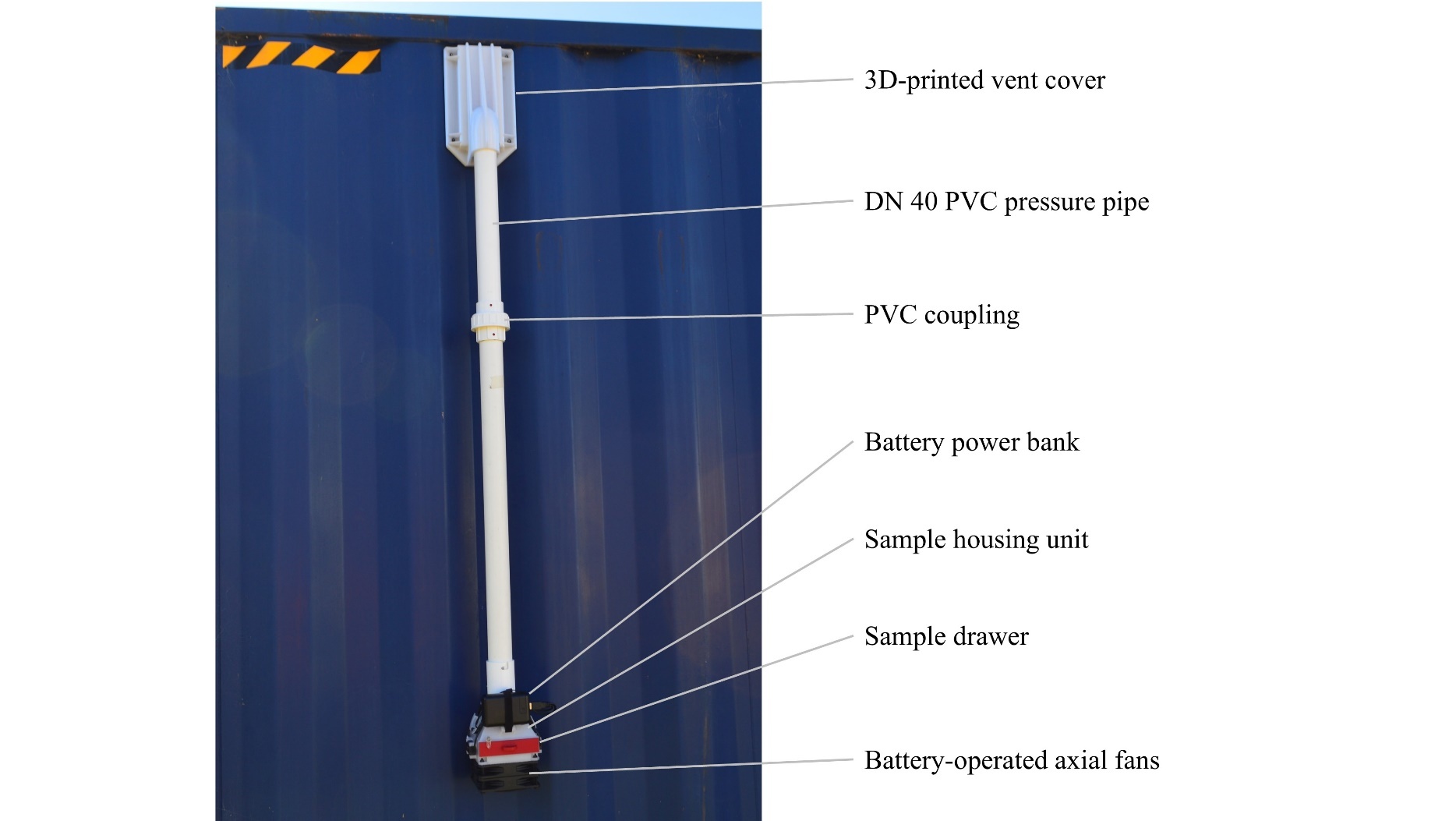
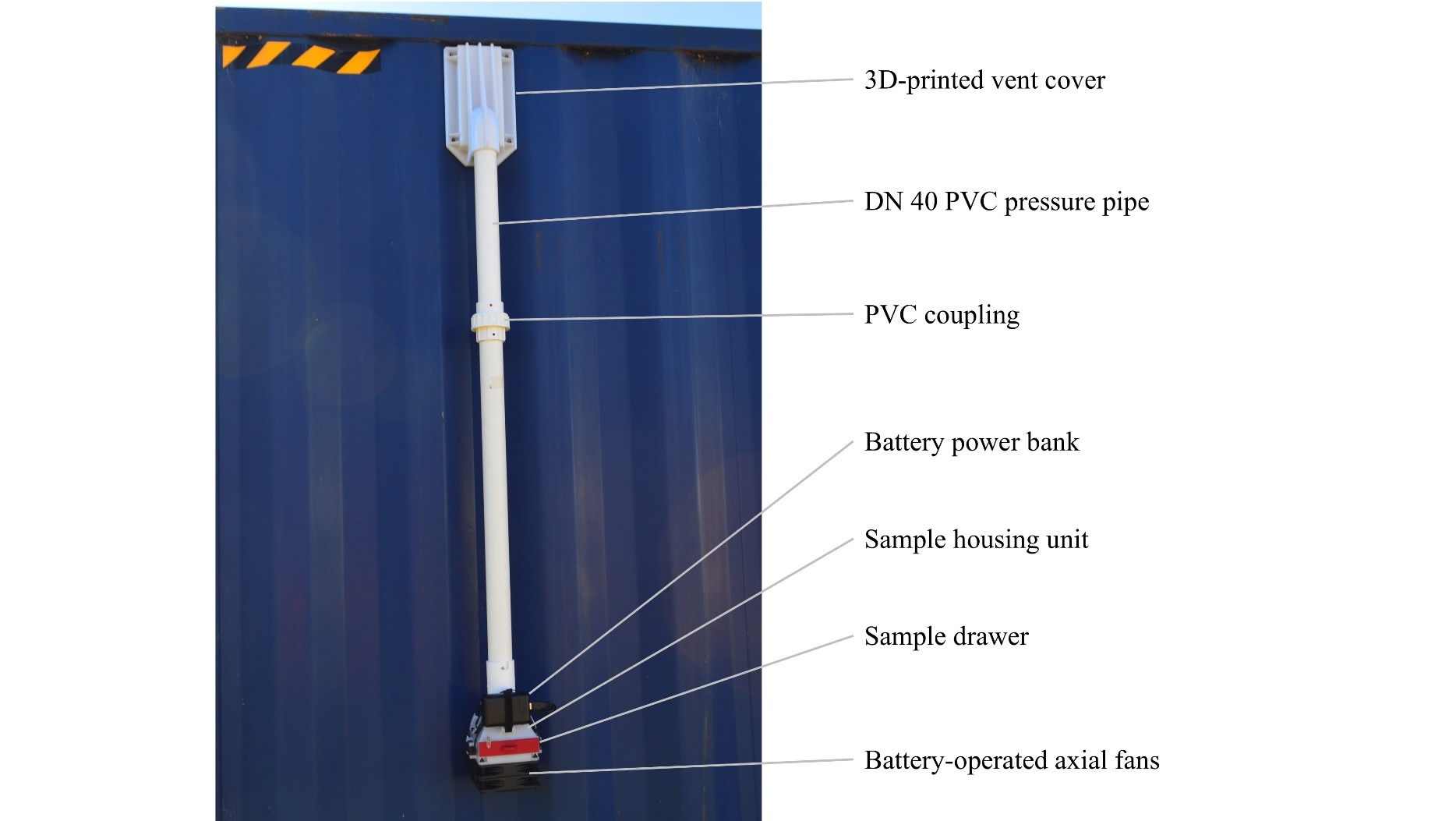
The first component of the system is the extraction assembly, which utilises the existing ventilation capacity of the container vents (Figure 1). A 3D-printed vent cover is positioned over the external container vent, tailored to fit the trapezoidal profile of the container wall. The cover is equipped with magnets at each corner, allowing it to securely attach to the steel container. An ethylene propylene diene monomer (EPDM) soft rubber seal is incorporated around the inner edge to prevent air leakage. This seal is achieved by the combined effect of the magnets and the suction generated by the extraction fans. While the cover can be placed over any vent on the container, it is optimised for installation over the vent located furthest from the container doors to enhance cross-airflow within the container when the blower is activated. The cover is connected to a sample housing unit via diameter nominal (DN) 40 polyvinyl chloride (PVC) pressure pipe (43 mm internal diameter, 700 mm long) and associated PVC couplings to provide length and limit potential personnel health and safety concerns by negating the need to reach the external vent by other means (i.e. ladder). The housing unit contains a sample drawer (internal dimensions 108 x 108 x 20 mm) for filter material and two inline 5V USB-powered battery-operated 120 mm DC axial fans (model no. N12U04, upHere, China), providing a maximum airflow of 1.7 m3/min per fan at 1300 rpm. The sample drawer is located 18 mm above the fans. The fans are powered by a 5.2 Ah portable battery power bank attached to the outside of the unit. Note that the device does not perform continuous monitoring; rather, a single sample is collected at a specific point in time wherever access to the container can be safely obtained.
2.2.2. Forced ventilation
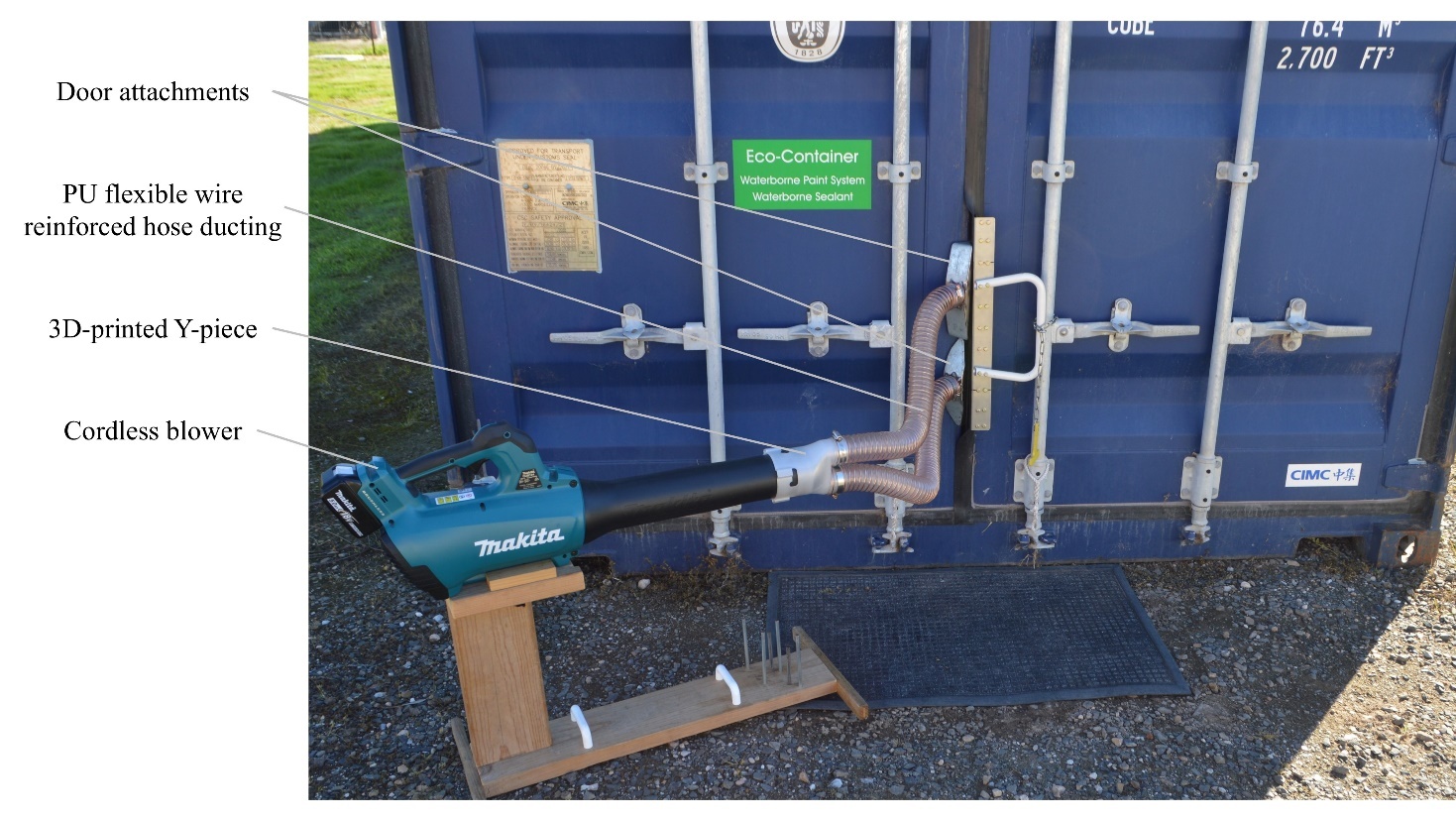
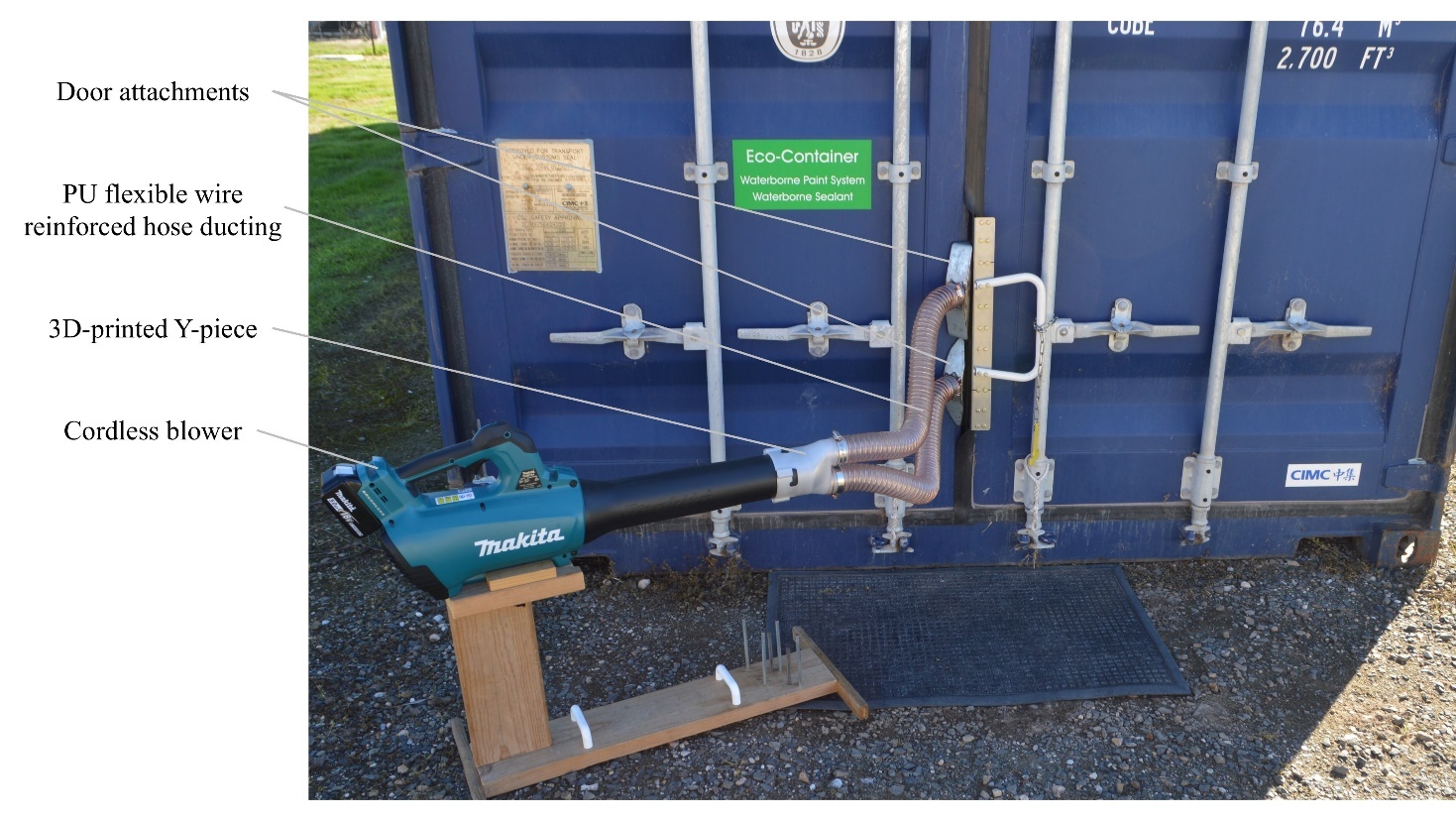
The second component of the system, to complement the extraction assembly, is the adaptation of a cordless blower (Figure 2). A DC 18 V brushless blower (model no. DUB184Z, Makita, Japan) with a maximum airflow of 13 m3/min, powered by a 5 Ah rechargeable battery, was used to promote airflow and positive pressure within the container. Two door attachments (each 220 mm long, 6 mm internal opening for airflow) were manufactured from stainless steel, designed to pass through the double rubber gasket to support the passage of forced air from the blower into the container, similar to a crevice tool. Attached to the blower outlet is a 3D-printed Y-piece which supplies air to both the door attachments via individually fitted 700 mm long polyurethane (PU) flexible wire reinforced hose ducting (51 mm internal diameter).
2.3. Experimental container fill conditions
Two of the most commonly encountered container types were used to assess the application of the device under different airflow and fill conditions: a standard ISO 20 ft dry container (total volume 33.2 m3, height 2.59 m, year of manufacture 2015) and a 40 ft high-cube dry container (total volume 76.4 m3, height 2.89 m, year of manufacture 2021). The containers were assessed empty, then packed with cardboard boxes of varying shapes and sizes (each box with a volume between 0.02 m³ and 0.24 m³) to mimic an operational scenario. The 20 ft container held 317 cardboard boxes for a total volume of 26.17 m³, equal to 79 per cent of the total container volume. This in turn corresponded to a free air space of 7.03 m³. The 40ft high-cube container held 445 cardboard boxes for a total volume of 36.85 m³ (volumetric filling of 48 per cent) in the half-full configuration, and 685 cardboard boxes for a total volume of 62.75 m³ (volumetric filling of 82 per cent) in the full configuration, corresponding to a free air space of 39.55 m³ and 13.65 m³, respectively. Boxes were stacked no closer than 0.2 m from the internal container vent holes and 0.5 m from the container doors.
2.4. Airflow evaluation
Average airflow through the air extraction device was recorded using a handheld anemometer (model no. HT625B Digital Anemometer, Habotest, China). A custom 3D-printed air cone sized to the exhaust of the air extraction device (below the fans) was used to direct and control airflow to the anemometer for consistent measurements. Average airflow was recorded over a 1 min period for i) extraction only (extraction assembly only), ii) forced ventilation only (blower only), and iii) mixed-mode ventilation (extraction and blower combined) conditions. These tests were repeated with a single layer of medical gauze in the filter tray to simulate a sample collection filter. Airflow was recorded for these conditions for an empty, half-full (40 ft container only) and full container (fill conditions reported in section 2.3), and each measurement was duplicated.
2.5. Ventilation efficiency
Smoke pattern tests are typically conducted in laboratory settings (i.e. clean zones or biological safety cabinets) to visualise airflow within a defined space. In this study, this principle was adapted to provide an initial proof-of-concept assessment of airflow behaviour, intended to inform and complement the ongoing development of the device. A red smoke emitter (80 g, 1 min burn time) was ignited and placed within 0.5–1 m of the container doors on a fibre cement board to create a non-flammable surface. The container doors were closed and left for approximately 5–10 min for the emitter to expire and the smoke to equilibrate within the container. With a piece of gauze in the filter tray, the extraction device was secured over the container vent furthest from the doors and engaged for a period of 10 s. Following this, the gauze was removed and a new piece fitted, then the process repeated for 20 s. Gauze was collected to represent every 10 s period from 10 to 60 s of run time. Then, new gauze was used to examine airflow over a 5 min period for each i) extraction only, ii) forced ventilation, and iii) mixed-mode ventilation conditions. Once all samples were collected, the container doors were opened to allow dissipation of any remaining smoke. Colour intensity of the gauze for each of the samples was noted and assessed as an indicator of airflow. These tests were repeated each with new smoke emitters for all container fill conditions outlined in section 2.3. Photographs of filters transposed onto a white sheet of paper were taken, with all filters corresponding to a particular fill condition captured in the same image to reduce influence from light and photograph quality on colour intensity interpretation. Colour intensity was assessed using ImageJ, an open-source image analysis software platform (Schneider et al., 2012).
2.6. Effect of temperature and humidity
Temperature and humidity measurements were recorded hourly from within both the 20 ft and 40 ft high-cube containers over a one-year period (1 January to 31 December 2024) using Mini Data Loggers (model no. 174H, Testo, Germany). These measurements were compared with recorded weather conditions in the Roseworthy area of South Australia as reported by the Bureau of Meteorology (BOM, 2025). Average daily temperatures were calculated using the minimum, maximum, 0900h and 1500h BOM data points. Average daily relative humidity was calculated using the 0900h and 1500h BOM data points, as minimum and maximum values were not available. Data analysis and visualisation was conducted using R (R Core Team, 2024).
3. Results
3.1. Airflow
The average airflow recorded varied depending on the container fill volume, presence or absence of a gauze filter, airflow conditions and even environmental conditions on sampling days. General observations were noted, as follows. For both containers, airflow doubled when a gauze filter was added under extraction-only conditions in both the empty and full container configurations. Airflow consistently doubled between the extraction only and forced ventilation conditions, except for the empty container with no gauze filter combination. Airflow increased again under mixed-mode ventilation conditions across all configurations, but particularly in the full container, demonstrating this combination provides optimal airflow. Airflow rates recorded varied across sampling days, hypothesised to be related to fluctuating environmental conditions. For example, the mixed-mode ventilation airflow recorded for the empty 20 ft container ranged from 0.15 m³/min in November 2024, to 3.6 m³/min in August 2025. However, the most important observation noted was the relative increase in airflow on a given sampling day, rather than necessarily the rate achieved. Theoretically, maximum airflow rates should correspond with the fan and blower outputs reported by the manufacturer.
3.2. Device performance
Airflow was visualised using red-coloured smoke, where smoke was seen passing from the origin to the far container vent within minutes. The intensity of the red colour captured on gauze filters significantly increased over time (10–60 s; p < 0.05) in all fill conditions, confirming the continuous passage of air through the container. When each component of the device was tested in isolation, both the fan and blower were effective in promoting airflow, however, the intensity and distribution of colour captured on the filters was significantly greater with the blower by comparison (p < 0.05). The mixed-mode ventilation approach further increased the capture of coloured smoke (p < 0.05). A relative increase in smoke capture was also noted between the empty and full containers, likely related to the increase in pressure and airflow observed in conjunction with the corresponding decreased free air space. Leakage of air through the floorboards, doors (especially where the blower was inserted) and vents was observed in both containers, particularly when the blower was engaged.
3.3. Temperature and humidity fluctuations
Temperature and relative humidity followed expected trends within the 20 ft container (Figure 3), with temperature increasing in the summer months (Dec–Feb) and humidity decreasing. Meanwhile, the inverse relationship was observed in winter (Jun–Aug). Temperature inside and outside the container remained consistent in winter (average temperatures varied by 0.2 °C), but was on average 2–2.5 °C warmer inside in summer. Comparatively, while it followed a similar trend, relative humidity was often significantly lower inside the container compared with outside.
_and_relative_humidity_(blue__right_y-axis)_recorded.tiff)
While temperature fluctuations in the 40 ft high-cube container followed a similar pattern (Figure 4), internal relative humidity deviated from the expected trend, showing no increase during the winter period as observed in the 20 ft container. Note that this container was approximately 80 per cent full with cardboard boxes from early 2024, whereas the 20 ft container remained mostly empty throughout this period.
_and_relative_humidity_(blue__right_y-axis)_recorded.tiff)
4. Discussion
4.1. Suitability for sample collection and operational use
The development of a simple, cost-effective and adaptable extraction device to collect air samples from shipping cargo containers offers several benefits. Most importantly, it allows for the non-invasive, rapid screening of container contents without needing to open the container. By designing a system that utilises the existing container vents, samples can be collected for downstream analysis without compromising cargo or damaging the container itself. Although this study did not directly validate the performance of the device through capture or measurement of volatiles, it demonstrated the general functionality and operational potential of the system, which we anticipate is sufficient for sample collection. The airflow rates and mechanisms explored here are consistent with those reported in studies of container pre-ventilation (Johanson & Svedberg, 2020). Flow visualisation models of container aerodynamics further demonstrate that applying suction to a sampling port or standard vent can generate airflow patterns within sealed containers. When a sufficient pressure differential is established, the resulting airflow can liberate and remove particulate and vapour traces, enabling effective sampling (Hargather et al., 2011). The method proposed could therefore provide authorities with an additional layer of intelligence by offering a more sensitive means of detecting VOCs emitted from a wide range of concealed contraband. As an example, narcotics, particularly synthetic drugs such as methamphetamine or cocaine, emit detectable odorous vapours that can be captured in air samples (Kerry et al., 2022; Rice & Koziel, 2015b; Zughaibi et al., 2022). Similarly, explosives, including trace amounts of trinitrotoluene (TNT), C-4 or their chemical precursors, release odorous volatile compounds which have previously been characterised through several analytical methods (Gallegos et al., 2023). Even biohazardous or biological materials such as wildlife products emit unique biomarkers which could be captured using this method (Brown et al., 2021; Moloney, Isafiade, et al., 2026; Ueland et al., 2016, 2020). Within an enclosed containerised environment, these VOCs are expected to equilibrate and reach concentrations amenable to detection, particularly given that some sensors operate at extremely low thresholds (Furton et al., 2015).
Note that the extraction device is intended exclusively for the collection of airborne samples onto a capture medium for subsequent analysis using downstream analytical or sensing platforms. It does not function as an autonomous detection system for specific toxic, noxious or radiological agents. Application to real-time gas- or radiation-specific threat detection would necessitate integration with dedicated sensing technologies, which was beyond the scope of the present study. However, future work evaluating the integration of on-site detection technologies, such as electronic nose systems, to enable instantaneous identification of selected target compounds at the point of sampling is being considered by the researchers.
The methodology proposed and the device itself are safe to use and will not compromise the health of workers as they are not directly exposed to any potentially hazardous materials. However, hearing protection is recommended when operating the blower (noise rating 96 dB). The vent cover developed can be used on any of the vents (assuming they are based on the ISO 668 standards) exposed on a container, allowing flexibility dependent on vent accessibility. Additionally, while we did not measure the pressure generated inside the container, we are confident it does not exceed dangerous levels. All device components are handheld and portable, suitable for both field applications and indoor use. The device is designed for rapid and straightforward deployment; it can be installed by a single operator and requires less than 10 min from mounting on the container to completion of sample acquisition. This minimal set-up time supports practical deployment in operational port environments by enabling rapid sample collection with minimal disruption to container handling workflows. All components of the current prototype are inexpensive and could be easily purchased by departments even with limited funding.
4.2. Ventilation and design efficiency
The smoke trials provided valuable insights into the airflow dynamics within an enclosed container and demonstrated how the device could be used to obtain a representative air sample. Optimal airflow was achieved using mixed-mode ventilation, combining the extraction assembly with the blower as a push-pull ventilation system. This configuration consistently facilitated the most efficient and reliable transport of air from the container doors to the sampling apparatus. Furthermore, it was demonstrated that the extraction assembly alone was capable of drawing air from the container and capturing a sample on a filter medium. However, the blower significantly enhanced airflow through the filter, indicating that while the extraction assembly contributes to sample collection, the blower plays a more pivotal role in promoting effective airflow. The advantages of increased positive pressure within the container were clearly demonstrated, particularly in containers with greater volumetric filling. Consequently, the implementation of mixed-mode ventilation, utilising both extraction and forced-air components, is recommended for optimal sample acquisition. In circumstances where blower deployment is impractical due to logistical constraints, the extraction assembly alone remains a viable alternative and may be affixed to any accessible container vent.
The efficacy of mixed-mode ventilation in improving the purging performance of airborne emissions (when compared to natural ventilation) has been previously documented (Braconnier & Keller, 2015), aligning with the findings of the present study. The airflow rates observed in this investigation are comparable to those reported by Johanson and Svedberg (2020) in their container purging experiments, where all extraction units achieved at least 100 m3/h (approx. 1.7 m3/min) and such flow rates were sufficient to reduce concentrations of chemical emissions. This suggests that the airflow levels achieved in the current study are adequate for the intended purpose of sample collection. It is important to note that the objective of the ventilation set-up described here is not the complete removal of VOCs, but rather the acquisition of a sample for further analysis. While elevated ventilation rates correlate with improved VOC clearance, further increases beyond the observed optimal range may offer limited benefit in the context of sampling rather than purging. Instead, the primary concern is the extent to which VOCs emitted from concealed materials concentrate within the container’s airspace. Given that airflow naturally follows the path of least resistance, the sampling strategy relies heavily on the adequate mixing of volatiles within the container to ensure that the extracted air sample is representative of the complete VOC profile. However, the physical and chemical characteristics of VOCs must also be considered. In practical settings, air circulation between densely packed goods is often limited, resulting in poor mixing. Moreover, the continuous emission and exchange of VOCs between cargo and the surrounding air is influenced by variables such as the duration of containment, temperature and humidity. Collection efficiency is also challenged by interference from competing odours or careful concealment. These factors play a critical role in determining the reliability of VOC sampling within sealed cargo environments.
4.3. Environmental influence
Temperature and relative humidity share an inverse relationship: as temperature rises, the air’s capacity to retain water vapour increases, causing relative humidity to decrease if moisture levels remain constant, and the opposite occurs when temperatures drop. This relationship was reflected in the climate data reported and is important to consider as temperature and relative humidity play crucial roles in the emission and capture of VOCs. Higher temperatures generally increase VOC emissions by enhancing their volatility, reducing adsorption to surfaces and accelerating diffusion into the air, thus contributing to an enhanced rate of off-gassing (Jung et al., 2022; Zhou et al., 2019; Zhu et al., 2024). Cycling of VOCs has been observed in containers with changes in temperature from 20 °C to 32 °C, with increased accumulation correlated with higher temperatures (Johanson & Svedberg, 2020). Relative humidity influences VOC emission differently depending on the compound; high humidity can increase the release of water-soluble VOCs and accelerate chemical reactions, while low humidity can also contribute to VOC release by affecting the sorption and diffusion properties of a material (Fang et al., 2004; Wolkoff, 1998; Xie & Suuberg, 2021). However, it is important to note that most of the research in this area investigates building materials for safety reasons. In terms of sample capture on a filter, temperature and relative humidity also impact adsorption efficiency. Higher temperatures typically reduce VOC retention by adsorbents like activated carbon as VOC molecules gain kinetic energy and desorb more easily (Lee et al., 2023; Wu et al., 2024). Meanwhile, high relative humidity can interfere with adsorption by competing for active sites, reducing capture efficiency, whereas low relative humidity enhances VOC adsorption, depending on the polarity of the compound (Qiang et al., 2019; Wu et al., 2024). It remains to be determined which filter medium is the most appropriate for the intended application of the device and the optimal sampling time to ensure the collection of a homogenised sample. Interestingly, it was observed that the relative humidity inside the 40 ft high-cube container was drastically influenced by the presence of cardboard boxes, an unexpected finding of the study. This is likely due to the porous nature of cardboard resulting in the increased absorption of moisture with increasing relative humidity. While not explored in this study, this finding suggests that the packaging material used to conceal contraband may not only physically impede VOC emission, but also influence the internal container environment in such a way that off-gassing may be affected.
4.4. Anticipated operational challenges
Translating the proposed approach from controlled and theoretical contexts to operational settings presents several practical and logistical challenges. The methodology is inherently constrained by container design characteristics, as it is only applicable to units that permit air exchange (e.g. standard dry containers equipped with ventilation or accessible door interfaces). This method is therefore not currently applicable to container types such as refrigerated (reefer) or tank containers. Containers that are fully sealed, stacked, or otherwise inaccessible cannot be assessed using the current system and adaptation for such configurations would require modifications beyond the scope of this study. In scenarios where only vent access is restricted, for example when vents are blocked by contents or sealed for fumigation, modifications are being considered to allow sample collection from the container doors. Feedback from local border authorities is also being considered to guide future improvements, such as incorporating a closed sampling system to minimise potential contamination, while maintaining the core functionality and findings outlined in this study. With the current proposed extraction system, safe sampling of all containers would not be feasible in most on-board vessel configurations. Accordingly, the system is primarily intended for use when a container has been singled out at the port with clear access to the vent and/or door. In practice, the device is designed to be deployed as part of a risk-analysis informed workflow, whereby high-risk containers are identified through coordination between the private sector, border security and law enforcement, and then repositioned to allow safe and effective sample extraction. Consequently, this approach is not intended to provide comprehensive coverage of global container traffic, but rather targeted applicability within a defined subset of container classes. Importantly, when integrated into a risk-based screening framework that prioritises high-risk consignments, selective deployment across a limited proportion of containers may still deliver substantial security and biosecurity value.
Sample collection is also dependent on VOC emission characteristics, which may vary depending on the substance, permeability potential (i.e. related to concealment), time in the container and environmental conditions such as humidity and temperature. To address these challenges, the proposed air extraction device must be designed to maximise airflow efficiency, ensure proper sealing to prevent contamination, and incorporate sensitive technologies, such as detection dogs or mass spectrometry, to identify trace substances accurately. In this regard, the extraction device requires access to sensitive downstream analytical techniques, which may not be available in all ports. The establishment of these processes should be considered before the implementation of the air extraction methodology to ensure efficiency and usability. Furthermore, the system itself would need to be integrated with existing port infrastructure and inspection workflows to enhance throughput without causing significant delays, though it is anticipated that with proper training this concern should be minimised.
4.5. Future directions
The experimental protocol presented was designed to approximate key aspects of operational port environments by utilising standard container configurations and ventilation pathways, while deliberately maintaining controlled conditions to enable systematic evaluation of airflow behaviour and sampling feasibility. In doing so, the study necessarily departs from full operational practice, including dynamic cargo handling, variable environmental conditions and risk-based targeting workflows that characterise routine port operations. These intentional simplifications allow the core technical performance of the air extraction device to be assessed in isolation, providing a foundational basis for subsequent testing under increasingly realistic operational and risk-management contexts.
The current study was intended to represent the first step in a staged translation pathway whereby controlled laboratory demonstrations inform subsequent pilot trials in progressively more realistic operational settings. To contextualise the current findings and guide future work, a series of priority next steps for further development and evaluation have been identified and are under way. The next critical phase would involve a controlled trial in which contraband is systematically concealed within a container, with the objective of confirming that air samples can be reliably collected and that target VOCs can be detected. Initial trials should be conducted using a priority material that is safe to handle and has a well-characterised VOC profile. In the context of wildlife trafficking, for example, pangolin scales represent a high-priority commodity (Moloney, Isafiade, et al., 2026). Building on prior success integrating air sampling with detection dog programs, utilising dogs as the downstream analytical method in the assessment phase provides a logical and low-risk progression for evaluating system performance under semi-controlled conditions (Moloney, Shute, et al., 2026).
Subject to successful outcomes, subsequent pilot trials would be conducted in operational environments using accessible, low-risk containers, with a focus on assessing sampling feasibility under realistic environmental conditions and operational constraints. This would include a systematic evaluation of performance metrics, including sample acquisition success rates, repeatability, sensitivity of downstream analyses and rates of false positives and negatives when integrated with complementary detection technologies. These trials would precede a limited-duration deployment in a port setting, contingent on funding and site access, in which container contents are unknown prior to screening to enable a blinded and operationally representative evaluation. During these later stages, structured feedback from customs operators would inform iterative refinement of the device, including optimisation of sampling durations, protocol standardisation and adaptation to support operational workflows. Collectively, this stepwise progression provides a pragmatic framework for transitioning from laboratory validation to real-world deployment, while identifying the container configurations and operational contexts in which effective air sampling can be achieved.
5. Conclusion
This study explores the development of a versatile air extraction device to collect samples from dry shipping cargo containers suitable for illicit contraband and hazardous material detection. The prototype presented here serves to demonstrate the feasibility and underlying methodology for air sampling from a sealed container environment. The key finding of the airflow trials suggests that it is important to consider mixed-mode ventilation for optimal air movement and sample capture, in agreement with previous work. This approach enables the safe, efficient and cost-effective sampling of high-risk containers at the port. However, implementation of this methodology necessitates access to downstream analytical methods. The use of the air extraction methodology must also account for logistical constraints to ensure feasibility without interfering with standard port operations. With the appropriate application, air sampling could help to overcome the limitations associated with current container scanners and thus enhance screening capabilities, in turn aiding law enforcement efforts in intercepting and detaining suspicious containers.
Acknowledgments
This work was supported by CMA CGM and The University of Adelaide. GKM received funding via the CMA CGM SA Supplementary Scholarship and the Australian Government Research Training Program Scholarship.