1. Introduction
Textiles are the fourth highest-pressure category for the use of primary raw materials and water, and fifth for greenhouse gas emissions (European Commission (EC), 2022). The European Union (EU) imports significant amounts of textiles. The value of EU textile imports reached EUR69 billion in 2020 (EC, 2021b). A significant share (30%) of textiles in the total EU imports of textiles is imported from China, which accounts for the largest global carbon emissions for EU consumption (a phenomenon known as pollution shifting) (Valodka et al., 2020). The number of imports is growing, and research based on data from 2000–2016 (Valodka et al., 2020) shows that the import of carbon emissions into the EU increased significantly from 2,548 kilotons in 2010 to 5,677 kilotons in 2016.
The growth in textiles imports affects the amount of textile waste in the EU, which is steadily increasing (EC, 2021a). Due to insufficient recycling capacities and other reasons (e.g. cost of recycling and related environmental requirements), the EU exports a significant share of its used textiles. The EU’s export volume of used textiles amounted to 1,250 kilotons in 2023 (as opposed to the imported 197 kilotons in 2023), making the EU a global leader in this area, accounting for 51 per cent of the total volume, followed by Asia (27%) (Dissanayake & Pal, 2023). This contributes significantly to systematic global environmental issues. The current extractive and linear economic system does not offer a clear solution to these issues. In response, the EU adopted the European Green Deal and shifted direction to the circular economy, that is, a model of production and consumption, which involves sharing, leasing, reusing, repairing, refurbishing and recycling existing materials and products as long as possible to extend the life cycle of products (Publications Office of the European Union, 2025).
The textiles sector and textile waste management are among the top priorities of the EU circular economy revealed in the comprehensive EU Strategy for Sustainable and Circular Textiles (the Strategy; EC, 2022). One of the action points of the Strategy is global progress towards more sustainable and circular textiles in international forums (G7, G20), in the context of the Global Alliance for Circular Economy and Resource Efficiency (GACERE) and the United Nations (UN) Environmental Assembly (EC, 2022). According to the EC, the transition to a more resource efficient, circular economy will have significant effects on international trade patterns. Global use of primary materials may decline, while secondary materials and sectors that do not rely on primary materials may see an increase, in particular, where overall economic activity is boosted by the transition. Furthermore, regional competitiveness in the production of materials-intensive commodities is expected to shift. Studies (e.g. Dissanayake & Pal, 2023) suggest that trade in used textiles has a positive impact on the environment as it minimises the use of raw materials and energy.
In the context of international trade and EU export volumes, the impact on importing countries should also be considered. Although trade in used clothing accounts for a relatively small share compared with trade in new clothing, at just below 0.6 per cent, it has a significant impact on developing economies. For instance, trade in used clothing carries a substantial value for some African countries, accounting for over one-third of all garments purchased by consumers in Africa (Hansen, 2004, as cited in Dissanayake & Pal, 2023). At the same time, it contributes to a decline in the local manufacturing sector, losses due to low-quality batches of textiles purchased, and fraud linked to power inequality. As argued by Dissanayake and Pal (2023), the economic impact also includes new employment opportunities in the recipient countries, income from trade licences, and new business models, for example, upcycling used clothing. However, these benefits may be rather limited in scope (Brooks, 2025).
Under current EU regulations (Directive 2008/98/EC of the European Parliament and of the Council of 19 November 2008 on Waste and Repealing Certain Directives, 2008), used clothing (and other used textiles) is considered municipal waste. In the recently adopted Regulation (EU) 2024/1157 of the European Parliament and of the Council of 11 April 2024 on Shipments of Waste, Amending Regulations (EU) No 1257/2013 and (EU) 2020/1056 and Repealing Regulation (EC) No 1013/2006 (2024), the EU has set, among other significant measures, several priorities related to waste handling, such as shortening transport distances, choosing the most effective destination for recycling or use, and analysing the legal framework related to environmental protection in the recipient’s country.
Despite the ongoing efforts to analyse the economic and environmental impact of used textiles and the goals to mitigate the negative impact established within the legal acts, there is still a lack of studies analysing the factors influencing trade in used textiles, that is, the direct and indirect reasons for EU exporters to choose particular recipient countries and to take the decision to export rather than recycle within the EU. The aim of the present article is to identify the key environmental and taxation policy factors that may impact the EU’s export of used textiles. Accordingly, the following main objectives have been established: (1) to identify the core environmental and taxation policy factors based on the analysis and systematisation of the scientific literature, and (2) to measure the impact of environmental and taxation policy factors using statistical data analysis and gravity approach modelling.
2. Literature review
The literature review was conducted by analysing relevant scientific articles selected using Google Scholar and the library databases of the University of Limerick (Ireland) and Vytautas Magnus University (Lithuania). The following keywords were used for the article search: ‘international waste trade’, ‘international textile trade’ and ‘international second-hand clothing trade’. The references were selected based on their relevance to the topic and alignment with the research objectives of the present study. The search was limited to peer-reviewed articles in English. The literature review also included the analysis of relevant legal acts accessed via the EUR-Lex database and other information available on the official websites of public bodies (such as the EU and the UN).
International bodies (such as the EU, the UN and the GACERE) place considerable focus on the sustainable and circular trade in textiles. For example, the UN has published its Sustainability and Circularity in the Textile Value Chain Report (Notten, 2020), while the EC has adopted the Strategy (EC, 2022), introducing the specific measures to be implemented, including international trade control, to address the challenges related to the export of textile waste. Researchers, including Kohn (2000), and Vallés-Giménez and Zárate-Marco (2021), argue that environmental taxes are among the factors affecting the volume of international trade in waste. Kellenberg (2012) claims that taxation policy does not affect trade due to the existence of so-called waste havens, which attract waste imports due to favourable waste-related regulations.
The gravity model is a recognised and well-established methodology for identifying and assessing the factors that influence the international trade of any goods and has been extensively employed by various researchers (e.g. Bergstrand, 1985; Maciejewski & Wach, 2019). The origins of the gravity model can be traced back to the early conceptual work of Isard (1954; as cited in Capoani, 2024), while the first empirical application of the model to international trade is commonly attributed to Tinbergen (1962; as cited in Capoani, 2024). Drawing an analogy with Newton’s law of gravitation, the gravity model assumes that trade between two countries is inversely related to the distance between them and positively related to their economic size (Capoani, 2024; Pascali, 2017). Gravitational equations have proven to be very effectively used as linear equations that can be employed to measure elasticity (Sinaga et al., 2019).
Although there are several studies on the international trade of waste using the gravity model (e.g. Higashida & Managi, 2014; Poon et al., 2024), no studies analysing trade in used textiles based on this model were found. This article aims to address this gap in scientific research. The findings could also serve as a useful tool for international bodies for the identification of specific measures aimed at more effective control of the used textiles trade and ensuring that the goals of sustainability and circularity are achieved.
To address gaps in previous studies of international trade in used textiles, various scientific publications were analysed to determine the factors in the gravity model that could reflect a country’s environmental and taxation policies.
Poon et al. (2024), Ugalde-Hernández (2021), and Chunsuttiwat and Coxhead (2024) use the Environmental Performance Index (EPI) in their gravity model-based research. The EPI is calculated by the Yale Center for Environmental Law and Policy, using data sets, science and technology to provide a comprehensive assessment of the state of sustainability around the world. In total, the EPI incorporates 58 indicators to rank 180 countries on their progress at mitigating climate change, safeguarding ecosystem vitality and promoting environmental health (Block et al., 2024). Chunsuttiwat and Coxhead (2024) use this independent variable in analysing plastic waste imports as a proxy for disposal cost and/or environmental regulation quality, assuming that countries with higher environmental regulation quality also have higher disposal costs. Similarly, in their research on waste trade, Ugalde-Hernández (2021) use the EPI as an indicator of health and ecosystem vitality, as well as the status of sustainability. Finally, the research by Poon et al. (2024) on industrial and textile waste includes an environmental stringency variable (WEPI) derived from the EPI, indicating the stringency of a country’s waste-related policies.
Cooperation agreements are also considered an important factor. Higashida and Managi (2014) developed a model analysing recyclable waste trade in the context of regional trade agreements by including dummy variables representing trade flows for the Asia-Pacific Economic Cooperation (APEC) and the EU. Chunsuttiwat and Coxhead (2024) use a time-variant bilateral indicator of common regional trade, which proved to be statistically significant.
Researchers also analyse the impact of tariff policy on international trade. Sinaga et al. (2019) include tariffs in their analysis of the international trade in fruits in Indonesia, while Chen et al. (2023) include the average import tariff on textiles imported into different countries. Chunsuttiwat and Coxhead (2024) use variables such as tariffs on plastic waste commodities. Datta and Kouliavtsev (2020) employ the gravity model to analyse apparel trade, viewing trade costs as an independent variable that is calculated as the sum of both transportation costs and tariff rates, classified by country and product category. Golovko and Sahin (2021) add an overall trade restrictiveness index, including tariff and non-tariff barriers, for international trade in Eurasian countries. Kohn (2000, abstract) analyses the impact of environmental taxes and concludes that where pollution haven and three-country effects that reverse comparative advantage are absent, ‘environmental taxes decrease (increase) the volume of trade between any two countries when the tax is larger in the country that exports (imports) the pollutive good’. The concept of waste havens is also used by researchers who claim that tariffs do not have any impact (e.g. Kellenberg, 2012).
Based on the literature review, the paper further analyses how the abovementioned factors, namely the environmental stringency and taxation policy both in the exporting EU country as well as in the recipient, impact the international trade amounts of used textiles.
3. Research methodology
The gravity model is applied as the main research method, using reliable sources of data, for example, Eurostat[1], Access2Markets[2], the United Nations Trade and Development Data Hub (UNCTADstat[3]), Centre d’Etudes Prospectives et d’Informations Internationales (CEPII[4]) and the Yale Center for Environmental Law & Policy.[5]
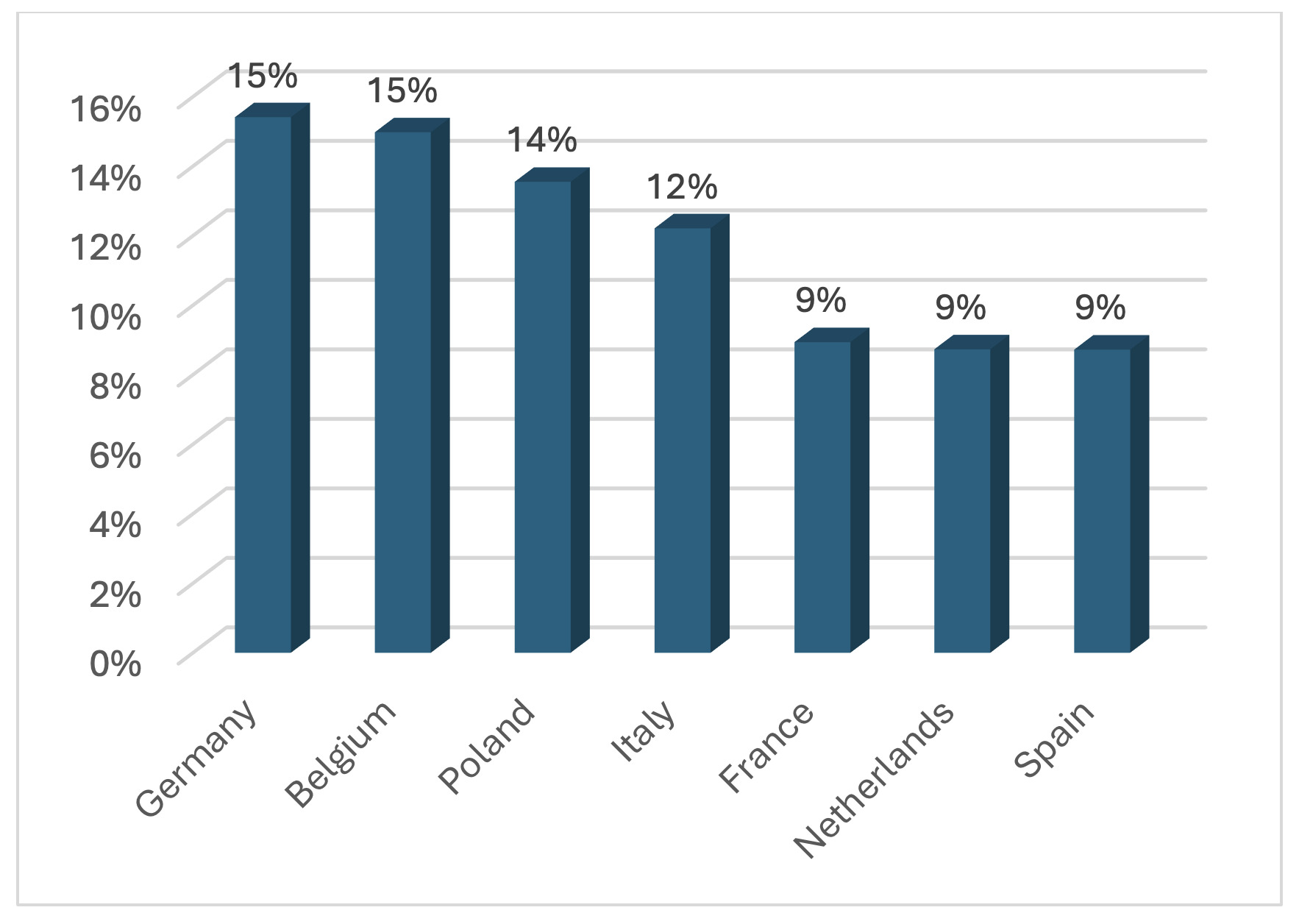
Given the limited scope of this study, the countries and trading partners included in the gravity model were selected to represent a significant proportion of EU trade. Accordingly, the EU countries with the largest exports of used textiles (with their combined export share accounting for 83% of total EU exports) were selected and include Germany, Belgium, Poland, Italy, France, the Netherlands and Spain (Figure 1). The countries were identified based on the Access2Markets data on the overall EU exports of goods under the CN code 6309. This CN code is used as a proxy for used textiles as elaborated later in the article.

Furthermore, the top five of each of these exporters’ destinations for used textiles were selected. The destination countries included the United Arab Emirates, Turkey, Tunisia, Pakistan, India, Ukraine, Togo, Nigeria, Guinea, Madagascar, Cameroon, Oman and Senegal. Data from five years (2019–2023) were used, resulting in a total of 175 observations. In this article, the export countries are further referred to as ‘host’ countries and destination countries are referred to as ‘partner’ countries.
The variables used to evaluate the factors that relate to environmental and taxation policy and influence the volumes of the EU’s international trade in used textiles are presented in Table 1 and described in more detail below.
As presented in Table 1, the export volume of used textiles (EXP_Q) is measured in quantity (tonnes), and not in value (e.g. EUR or USD), because in the context of the circular economy, control measures should focus on the quantities of materials. Quantity is also an important metric when evaluating, for example, land dumping and incineration. The volume in tonnes is also indicated in the Strategy related to the exports of textile waste (EC, 2022). Moreover, used textile is sold in batches with a price set per weight instead of price per unit (World Integrated Trade Solution, n.d.). The volumes in value, on the other hand, can be misleading because used textiles may be treated as waste (no economic value) from the perspective of the exporter, or even have a negative value (due to compulsory recycling costs).
To evaluate the export volumes of used textiles, the statistics of exports of a broader group of items were used, that is, items falling under Combined Nomenclature code 6309 ‘Worn clothing and other worn articles’. Following Council Regulation (EEC) No 2658/87 of 23 July 1987 on the Tariff and Statistical Nomenclature and on the Common Customs Tariff (1987), known as the Combined Nomenclature or CN, code 6309 includes clothing and clothing accessories, and parts thereof, blankets and travelling rugs, bed linen, table linen, toilet linen and kitchen linen, furnishing articles, other than carpets, footwear and headgear of any material other than asbestos. To be classified under this heading, the articles mentioned above must meet both of the following requirements: (i) they must show signs of appreciable wear, and (ii) they must be presented in bulk or in bales, sacks or similar packings. Accordingly, not only used textiles but also several other sorts of articles are included under this heading. However, for the purpose of this study, this CN heading was chosen because: (i) it includes used textiles from various clothing, (ii) the exports of other articles included also raises the same issues as used clothing, and (iii) the classification is universal. Universal classification means that items are classified for international trade purposes in the same manner by all the members of the World Trade Organization, which allows for a unified approach both from the host, as well as from the partner country. The use of the CN code, which coincides with the Harmonised System (HS) code for the first six digits, has also been adopted by other authors analysing trade in used clothing (e.g. Abimbola, 2012).
Gross domestic product of the host and partner country (GDP_H, GDP_P) are the core gravity model variables chosen and are expressed in currency units (USD), rather than per capita, to account for the size of the country’s economy rather than productivity. Distance (DIST) indicates the distance between the different countries’ capitals and is another core gravity model variable serving as a proxy for transportation smoothness and cost.
Import duties applied by the partner country are expressed as percentages and, in some instances, were equal to zero, which precluded their use in the logarithmic form in the gravity model of the ordinary least squares (OLS) function. The import tax on used textiles in the partner country (TAX_P) was transformed into a gross tariff rate by adding 1 (1+TAX_P) to avoid problems when taking logarithms, in line with previous research by Baier and Bergstrand (2007) and Hayakawa and Yoshimi (2024).
The environmental tax (ENV_H) variable indicates the amount of revenue collected from the environmental taxes in the host country and is taken from Eurostat data. Environmental tax revenue is divided into four main categories: energy taxes, transport taxes, pollution taxes and resource taxes (Eurostat, 2025). This variable was used as a proxy for environmental taxation level in the host country.
Environmental performance index (EPI_P, EPI_H) was used as a proxy for environmental regulation stringency. The index is published once every two years (2018, 2020, 2022, 2024). The present study analyses the panel data for the years 2019–2023; therefore, to prepare data suitable for use in the regression, the EPI index from 2018 is used for the year 2019, the EPI from 2020 is used for the years 2020 and 2021, and the EPI from 2022 is used for the years 2022 and 2023.
The gravity model was estimated using the OLS function, as presented in Equation 1:
Equation 1. Gravity-model based OLS function.
\[\begin{align} ln({EXP\_ Q}_{ijt}) =& \beta 0 + \beta 1 ln({GDP\_ H}_{it}) + \beta 2 ln({GDP\_ P}_{jt}) \\ &+ \beta 3 ln({DIST}_{ij}) + \beta 4 ln({EPI\_ H}_{it}) \\&+ \beta 5 ln({EPI\_ P}_{jt}) + \beta 6 ln({ENV\_ H}_{it}) \\&+ \beta 7 ln(1 + T{AX\_ P}_{ijt}) + \varepsilon_{ij} \tag{1} \end{align}\]
Descriptions of the variables are provided in Table 1. Indices (i, j, t) refer to: i – country of export (EU/host country), j – country of import (non-EU/partner country), t – time; t = 1, …5. β0 – constant, β1,…β7 – coefficients, that is, structural parameters of the model for the mentioned variables, ε – random element.
The OLS model allows the analysis of the statistical and economic significance of the independent variables in relation to the dependent variable (trade volume in the present study). The logic of OLS testing is to test the null hypothesis (i.e. that the coefficient (β) is statistically different from zero), as well as the alternative hypothesis. Where the coefficient (β) is statistically different from zero, it can be concluded that an independent variable influences the dependent variable. Various tests (e.g. related to heteroskedasticity, collinearity) were also used to test the validity of the model, that is, to test if the estimated coefficients and statistical tests can be trusted. Statistical analysis was performed using gretl (Gnu Regression, Econometrics and Time-series Library) – an open-source cross-platform software package for econometric analysis.[6]
4. Results and discussion
The White test (White, 1980) indicated the presence of heteroskedasticity, that is, the residuals from the regression were found to depend on the values of the explanatory variables. This is usually observed in research related to international trade (Silva & Tenreyro, 2006) as the units of observations (countries) and other variables vary significantly in size. To address this issue, robust standard errors were used in the model. The results are presented in Table 2.
The indicators R-squared and adjusted R-squared are both equal to 0.87, meaning that the model explains more than 87 per cent of the variation of trade flow (dependent variable), which proves a strong overall fit of the model in explaining the trade in used textiles. The independent variables were minimally correlated (VIF is below 2); therefore, the coefficient value was not likely to be distorted by multicollinearity.
The results suggest in this study, international trade in used textiles only partly follows the classical gravity model approach. The impact of distance between the trading partners (ln_DIST) agrees with this approach, that is, the study confirmed that the shorter the distance, the larger the trade volume. However, the economic significance of this factor was low, with a coefficient of −0.0156, meaning that a 1 per cent increase in the geographical distance between the exporting and importing countries was associated with a 0.0156 per cent decrease in export flows. This figure is small compared with other gravity model-based studies, for example, Head and Mayer (2014), who demonstrate that median export elasticity in relation to distance varies from −0.89 to −1.14. Furthermore, contrary to the classical gravity model approach, the size of the economy of the exporting country (ln_GDP_H) was negatively related to export volumes, that is, the larger the export country’s economy, the smaller the export volumes. Finally, the impact of the size of the partner’s economy (ln_GDP_P) proved to have a statistically insignificant effect on the international trade flows of used textiles (the coefficient was positive but very low, at 0.003). These results suggest that, for trade in used textiles, factors other than those included in the core gravity model need to be considered to explain these flows.
The results also confirm that, similar to trade in other waste-related sectors (e.g. plastic waste; Chunsuttiwat & Coxhead, 2024), the stringency of the environmental policy of both exporting and importing countries has an impact on trade volumes. The results show that export volumes from the countries with a higher EPI are also higher. Moreover, the variable ln_EPI_H proved to be one of the most economically significant variables, with a coefficient of 0.8. This means that as the log-to-log model was used, an increase in the EPI score by 1 per cent would lead to an increase in used textiles exports from the respective country by 0.8 per cent. This confirms the approach that environmental stringency incentivises export of used textiles.
Similarly, the environmental policy stringency in the destination country also proved to be economically significant. The coefficient of the variable ln_EPI_P was −0.21, meaning that in the event of an increase in the partner’s EPI score by 1 per cent, the import flows would be 0.21 per cent lower, ceteris paribus.[7] This suggests that lower environmental stringency attracts the imports of used textiles.
The level of environmental taxes in the EU countries that export used textiles also proved to have an economically significant influence on the export trade volumes. The study demonstrated that the amount of environmental taxes collected in a specific country is positively related and has an economically significant influence on the export amounts of used textiles from that country (the coefficient of ln_ENV_H is 1.03). In other words, an increase in the collected environmental taxes by 1 per cent leads to an increase of 1 per cent in used textile exports. This confirms that higher taxation levels in the host (exporting) country lead to higher export amounts to mitigate the tax cost in the host country.
The results of this study confirm that the larger the import duty rate (tariff) set in the country of destination, the larger the import flows to the respective country. Specifically, an increase in tariffs by 1 per cent led to an increase in imports by 0.35 per cent (the coefficient of ln_1+TAX_P is 0.35). The results could be explained by several factors. First, used textiles are usually treated as waste in the exporting (host) country, thus their value for customs purposes is low, leading to insignificant payable import taxes and, as a result, insignificant trade costs. Therefore, an increase in the tariff does not in fact increase the cost significantly. In other words, imports of used textiles may be less inelastic to change in tariffs and, accordingly, importing (partner) countries might be incentivised to raise the tariffs to increase government revenue. The results of this study also support Kellenberg’s (2012) research on waste havens, in which import duties have no negative impact on import amounts. Finally, the results of this study could have been influenced by certain trade exemptions or schemes that were not considered. As there is no clear explanation, the effect of tariffs on trade flows requires further analysis.
5. Conclusion
This study has demonstrated that core gravity model factors, such as the GDP of the host and partner country and the distance between the countries, are not sufficient to explain the used textiles trade. Hence, other factors must be considered. In the research model presented, both environmental stringency and taxation-related factors were included and proved to have an impact, that is, they are economically significant in the used textiles trade. The most economically significant factors were found to be the environmental stringency and high environmental taxation level of the host (exporting) country. Such results can be explained by the fact that the aim of the exporters is to reduce compliance- and tax-related costs in the exporting country by exporting used textiles to the countries with less stringent environmental requirements.
The study also showed that higher import taxes (tariffs) did not preclude imports into the countries applying them. Moreover, import flows to the countries applying higher import taxes proved to be higher. The reason for such economic behaviour could be tariff-inelastic demand for used textiles imports due to the relatively low value of used textiles, and consequently, low payable import taxes leading to a less significant proportion of trade costs. In other words, higher import taxes do not lead to a significant increase in trade costs, and this factor might be used as a means of increasing budget revenue. Moreover, certain favourable treatment schemes (unaccounted for in this study) might be applicable in countries with higher import tariffs, which incentivise the imports of used textile while the most-favoured nation rate remains unchanged.
This study has demonstrated that the factors that can be controlled by the EU member states, such as the strictness of the environmental regulations and the level of environmental taxation, have the most significant effect on trade in used textiles. Reducing taxes and loosening regulations to reduce exports does not seem to be in line with EU sustainability goals. However, given that taxation is one of the factors with a significant effect, export customs duties could be introduced. However, the type of duties should be adjusted, that is, changed from ad valorem duties (duties that depend on the value of goods) to specific duties (duties that depend on the amount of goods), which would eliminate the effect of the low value of used textiles that are not elastic to the ad valorem duties.
There is room for further research in this area, such as expanding the number of countries and the time period covered, considering the movement of used textiles inside the EU (top exporters might also include transit countries only, and the amount of used textiles exported from that particular country could be subject to adjustments). The analysis could also be expanded further to explore potential causes behind the higher imports of used textiles into countries that apply higher ad valorem duties to this category of goods.
Declaration of generative AI and AI-assisted technologies in the manuscript preparation process
During the preparation of this manuscript, the authors used DeepL and ChatGPT to assist with language editing, including improvements to grammar, clarity and readability. All AI-assisted outputs were reviewed, verified and revised by the authors. The authors take full responsibility for the content of the manuscript and approve its final version.