1. Introduction
The protection of intellectual property rights (IPR) has emerged as a critical challenge for customs agencies worldwide, particularly in developing countries where institutional capacities and intersectoral coordination are limited. In Ecuador, the Servicio Nacional de Aduana del Ecuador (SENAE), the National Customs Service of Ecuador, continues to struggle with the enforcement of IPR, partly due to the absence of strong and structured public-private collaborations. These limitations hinder SENAE’s ability to develop comprehensive responses to the increasing complexity of cross-border IPR violations.
Scholarship in public management has long stressed that sound administration is central to translating government policy into practice (Lynn, 2006). Since the 1970s, public sector reforms across the globe have embraced principles from private sector management, giving rise to the framework of New Public Management (NPM). This framework promotes the integration of private sector practices, such as performance-based strategies, technological adaptation and collaborative governance, into public administration (Alford & Hughes, 2008; Hood, 1990). The ultimate aim is to enhance both organisational efficiency and the creation of social value by public institutions.
Two practices adopted from the private sector have gained increasing relevance in public sector reforms: technological adaptation and inter-organisational collaboration. The former has enabled private companies to develop competitive advantages and operational efficiency, particularly through the use of information and communication technologies (ICT). The latter, reflected in vertical and horizontal alliances within the value chain, has facilitated knowledge exchange, risk-sharing, and innovation. In this context, public organisations are encouraged to emulate such collaborative and technology-driven models, especially in areas where multi-stakeholder engagement is vital, such as customs enforcement of IPR.
Despite the potential of these practices, public-private collaborations continue to pose substantial challenges. Scholars and practitioners alike have raised concerns regarding misaligned incentives, conflicting institutional logics and power imbalances in such collaborations (Boyne, 2002; Caldwell et al., 2017; Kivleniece & Quélin, 2011). While private firms often pursue value appropriation through market rents, public agencies are driven by the mandate to generate social value for broad constituencies. The strategic alignment of these divergent goals remains an unresolved issue in the public management field.
In the specific domain of customs administration, scholarly attention to public-private collaborations remains scarce. Even fewer studies have examined how such collaborations can lead to social value creation – not merely through enforcement, but through innovative practices such as the reuse or recycling of counterfeit goods seized at borders. This is a missed opportunity, particularly in contexts like Ecuador, where customs agencies face resource constraints but hold untapped potential to contribute to social development goals through adaptive policy frameworks.
Moreover, the integration of ICT in customs operations presents a compelling but underexplored avenue for reform. While much has been theorised about the role of ICT in enhancing public sector efficiency, little empirical work has investigated its role in customs-specific IPR enforcement, especially in Latin American contexts. Given the increasing digitisation of trade and the proliferation of counterfeit goods, the modernisation of customs systems via ICT is no longer a technical upgrade but a strategic necessity.
This article seeks to contribute to public administration and IPR enforcement literature by examining how customs agencies, particularly in developing countries, can enhance social value creation through two main channels: (1) public-private collaborations, and (2) ICT-driven reforms. Using SENAE as a case study, the paper explores the feasibility of innovative approaches such as recycling seized counterfeit goods, establishing public-private frameworks for IPR protection and implementing digital systems to support more efficient and transparent enforcement.
The study is theoretically grounded in NPM and value co-creation frameworks, and aims to bridge the gap between policy aspirations and operational realities in the customs domain. It proposes actionable recommendations for customs officers, public managers and policymakers, including the development of standardised procedures, institutional reforms and digital infrastructures to support IPR protection at national borders.
2. Literature review
The intersection of digital transformation, IPR enforcement and public-private collaboration has gained renewed relevance in the context of post-pandemic global trade. This literature review synthesises key perspectives on the modernisation of customs procedures, the creation of social value and the increasing need for collaborative governance models in IPR protection.
2.1. Digital transformation in customs and intellectual property rights enforcement
Digital technologies have fundamentally reshaped the operational dynamics of public institutions, especially customs administrations. Westerman et al. (2014) describe digital transformation as a coordinated organisational effort, aligning internal capabilities with digital tools to enhance performance. In the public sector, this process often requires strong intergovernmental coordination, transparency and user-centred service delivery (Nielsen & Jordanoski, 2020).
Weill and Woerner (2018) emphasise the disruptive potential of digitalisation, which can simultaneously open new value streams and challenge established systems. Particularly in Customs, automation and data integration are critical for addressing the surge of counterfeit goods facilitated by global e-commerce (Bughin & Zeebroeck, 2017; Catalini, 2017). Technologies such as blockchain and digital automation enable real-time tracking of cargo and improve the accuracy of risk assessments (Okazaki, 2018), reducing dependence on physical inspections and expediting enforcement actions.
The integration of ICTs in Customs is especially relevant for IPR enforcement, where traditional manual controls often prove insufficient. As Ragavan and Deswal (2023) note, the decentralised nature of technologies such as blockchain poses both legal and technical challenges in monitoring IPR compliance. However, with appropriate legal frameworks and automated data collection mechanisms, digital customs procedures can become key drivers of transparency, efficiency and effective IPR protection.
2.2. Social value creation through public-private collaboration
The notion of creating shared value, as proposed by Porter and Kramer (2011), underscores how institutional collaboration can generate economic and social benefits simultaneously. In customs enforcement, such value arises when public agencies work with private stakeholders – brand owners, manufacturers and industry associations – to co-develop solutions to complex issues like counterfeiting and illicit trade.
Several studies emphasise the potential of collaborations to pool resources and expertise (Caldwell et al., 2017; Kivleniece & Quélin, 2011). For instance, collaborations with IPR holders can ensure more accurate identification of counterfeit products, while private sector support may reduce the environmental impact of disposal through recycling initiatives (Brohm, 2018). These collaborations contribute not only to operational efficiency but also to societal outcomes such as consumer safety and environmental sustainability.
Importantly, public-private collaborations must navigate fundamental differences in organisational culture, incentive structures and legal frameworks (Warner & Bel, 2008). Hybrid governance models that align objectives and foster mutual trust are more likely to succeed than purely transactional arrangements (Smith & Thomasson, 2018).
2.3. Enhancing intellectual property rights enforcement through collaborative governance
Effective IPR protection in global trade increasingly depends on coordinated governance. Schaeffer and Loveridge (2002) define public-private collaboration as a joint effort to pursue goals that neither sector could achieve independently. In Customs, this includes shared access to databases, joint inspections and cooperative risk assessments (Mahlunge, 2018; World Trade Organization, 1994).
However, challenges persist. Public agencies often lack high-powered incentives and flexible structures, while private firms are driven by profitability and brand protection (Fama & Jensen, 1983; Williamson, 1999). These divergences can lead to misaligned incentives and suboptimal collaboration. Nevertheless, literature suggests that when trust, communication and goal alignment are present, collaborations can create both social and commercial value (Caldwell et al., 2017).
2.4. Counterfeiting in the post-pandemic era
The COVID-19 pandemic significantly exacerbated illicit trade, particularly in pharmaceuticals and medical supplies. Criminal groups exploited global supply chain disruptions and the surge in online commerce to distribute counterfeit goods (Moberg & Pickard, 2020). According to the Organisation for Economic Co-operation and Development (OECD, 2008), illicit trade in medicines alone increased by 25 per cent post-pandemic, exposing vulnerabilities in enforcement mechanisms.
The digital nature of e-commerce platforms complicates traceability and enforcement. Authorities often lack jurisdiction or technological means to identify counterfeiters operating online (Allenbach-Ammann, 2022). In response, platforms have implemented supplier verification and product tagging systems. Blockchain and copy-detection technologies are emerging as potential tools to address these challenges, but require coordinated action across sectors to be truly effective.
2.5. The Japanese Customs model: a comparative benchmark for intellectual property rights enforcement
Among developed customs administrations, Japan offers a widely referenced model of collaborative, technology-enabled IPR border enforcement that is instructive for reform in developing contexts. Central to the Japanese approach is the ‘Application for Suspension’ system, through which rights holders formally request that Customs initiate verification procedures when goods suspected of infringing their rights are detected among imports or exports. The system covers a broad spectrum of rights – patents, utility models, designs, trademarks, copyrights and neighbouring rights, plant breeders’ rights and rights protected under the Unfair Competition Prevention Act – and applications, lodged with intellectual property investigators stationed at customs offices nationwide, remain valid for a renewable period so that enforcement is applied consistently across all ports (Japan Customs, 2024).
Two features make this model particularly relevant to the present study. First, it institutionalises the public-private interface: rather than relying on ad hoc contact, rights holders supply Customs with structured identification information in advance, which is then embedded in risk-based targeting. Second, verification procedures are transparent and bilateral – both the rights holder and the importer are notified and invited to submit their views before a determination is made – while Japan Customs publishes annual seizure statistics and procedural guidance on public-facing platforms. This combination of formalised cooperation, centralised information and procedural transparency demonstrates that when rights-holder engagement is embedded in both automated risk management and public policy, enforcement efficiency rises while operational friction falls. Endorsed within World Customs Organization (WCO) capacity building programs, the Japanese experience thus provides a concrete benchmark against which Ecuador’s more fragmented arrangements can be assessed, and to which this paper returns in its concluding recommendations.
2.6. Gaps and research directions
This literature review identifies three main gaps:
-
insufficient empirical evidence on the effectiveness of public-private collaborations in customs IPR enforcement, particularly in developing countries
-
limited integration of digital tools (like blockchain and AI) into policy frameworks for IPR protection
-
the underexplored role of social value creation in evaluating public sector performance beyond economic metrics.
Future research should focus on case studies of digital customs reform, metrics for evaluating social value in enforcement and mechanisms to institutionalise trust and coordination between sectors.
3. Research design
This study adopts a qualitative case study approach to explore how public-private collaborations in customs enforcement can enhance the protection of IPR and generate social value, with a focus on SENAE. A qualitative method was selected due to its capacity to uncover complex, real-life dynamics within institutional and regulatory frameworks (Denzin & Lincoln, 1994; Miles & Huberman, 1994). Given the research focus on ‘how’ institutional actors collaborate and ‘why’ implementation gaps persist in public-private initiatives, a case study methodology is both appropriate and strategically aligned (Yin, 1994).
3.1. Case study approach and rationale
The case study methodology enables an in-depth investigation into a contemporary phenomenon within its real-life context, especially where the boundaries between the phenomenon and its context are blurred (Yin, 1994). This is particularly suitable for customs governance, where procedural enforcement, legal frameworks and informal institutional practices intersect. SENAE was selected as the core case due to its central role in border enforcement and its untapped potential for deeper collaboration with private stakeholders in IPR protection and counterfeit goods management.
Theoretical sampling guided the selection of the case (Eisenhardt, 1989), focusing on two interrelated dimensions of public-private collaboration: (1) coordination mechanisms for IPR enforcement, and (2) the potential for social value creation through the reuse of seized counterfeit goods. These dimensions emerged as critical gaps in both the literature and practice in the Ecuadorian context.
3.2. Context and case setting
Ecuador presents a unique setting for studying IPR enforcement due to its legal commitments to international treaties, for example, the Agreement on Trade-Related Aspects of Intellectual Property Rights (TRIPS) (WTO, 1994) and World Intellectual Property Organization (WIPO). Legislative amendments in 2021 to the country’s trade and customs legislation (National Assembly of Ecuador, 2021) further strengthened enforcement mechanisms through Ecuadorian Customs and Intellectual Property Rights Agency (SENADI). However, operational fragmentation and the absence of standardised inter-agency procedures continue to limit effective enforcement and collaboration.
SENAE operates under the national law of the Organic Code of Production, Trade and Investment (COPCI), which grants Customs the authority to suspend operations involving goods that potentially infringe IPR. While the legal basis exists, there is no unified or institutionalised mechanism to coordinate actions between customs officers, trademark owners and legal representatives. This institutional gap served as the empirical focus of this study.
3.3. Data collection
Data were collected through two main sources: semi-structured interviews, conducted using the protocol provided in Appendix A, and secondary documentation. Ten interviews were conducted with key stakeholders: six officials from SENAE (customs officers and clearance chiefs), two lawyers from IP law firms and two senior staff from SENADI. Interviews were conducted remotely via Zoom and WhatsApp during August 2023. Each interview lasted approximately 30–60 minutes, with open-ended questions designed to explore institutional roles, collaboration experiences, legal procedures and the feasibility of social reuse of counterfeit goods.
Secondary data – including institutional documents, policy guidelines and internal reports – were obtained via formal requests to customs agencies, an IPR agency and collaborating law firms (anonymised to preserve confidentiality). This triangulation approach ensured a robust understanding of institutional practices and regulatory frameworks.
3.4. Analytical strategy
Given the exploratory nature of this study and the limited prior research on public-private customs collaboration in developing contexts, an explanation-building technique was used (Yin, 1994). This iterative analytical strategy involved evaluating empirical patterns, updating theoretical propositions and reinterpreting data to refine emerging themes. This approach supports the study’s goal of contributing to theory-building in the domain of collaborative governance and enforcement mechanisms in customs operations.
3.5. Research quality and validity
To ensure rigour, the study followed Yin’s (1994) framework for research quality in case studies. Construct validity was addressed by using multiple data sources and ensuring a clear chain of evidence from interview protocols to findings. Internal validity was strengthened through explanation-building and cross-interview thematic validation. External validity was pursued through analytical generalisation, seeking to extend findings to theoretical constructs rather than populations. Reliability was supported through detailed documentation of procedures and data collection protocols, enabling potential replication by other researchers.
4. Findings
This section presents the data and discusses the findings aimed at improving organisational performance in IPR detection and seizure, and enhancing IPR protection in Ecuador. The interviews conducted analysed the current state of IPR enforcement in SENAE, highlighting flaws identified by key stakeholders and suggesting measures to strengthen public-private collaboration and generate social value from seized counterfeit goods. Both primary data from interviews and secondary data from official reports and law firms were integrated to provide a comprehensive view.
4.1. Demographics of respondents
This section focuses specifically on the six SENAE officers, who constituted the majority of respondents. They formed a knowledgeable group with extensive experience in customs and IPR matters. Notably, 60 per cent of these officers had over 10 years of experience, with an average tenure of 12.8 years in customs operations. Half of the SENAE respondents held leadership roles at customs headquarters, involved in policy and oversight functions, while the other half worked directly in the clearance department, managing trademarked merchandise and frontline IPR enforcement. This blend of leadership and operational roles provided well-rounded insights into Ecuador’s customs challenges related to IPR protection.
4.2. Interview findings
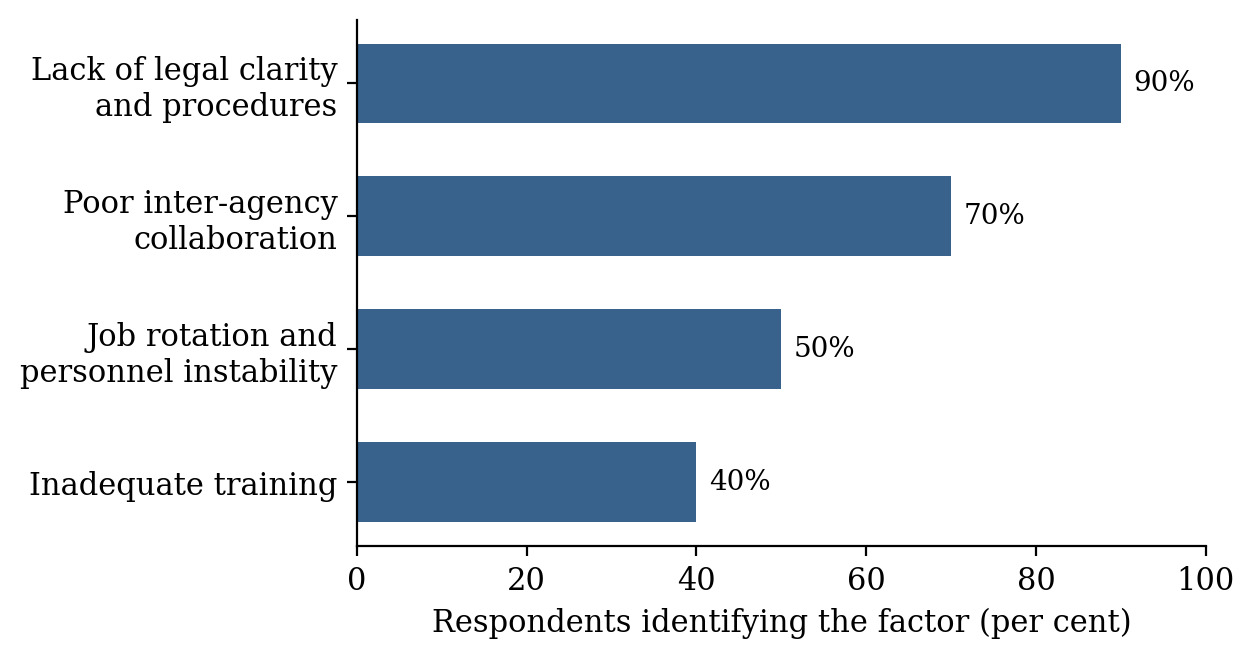
The qualitative analysis distilled four major themes from the interviews: (1) causes of poor IPR protection; (2) need for ICT reform; (3) feasibility of recycling/reusing counterfeit goods; and (4) impact of the COVID-19 pandemic on IPR infringement. Respondents also discussed the potential, and barriers, for public-private collaboration. Figure 1 summarises the perceived causes of weak IPR protection.

4.3. Causes of poor intellectual property rights protection
The interviews surfaced four principal causes of weak IPR protection, which are discussed in turn below.
4.3.1. Necessity of customs legal reform
A clear majority (90%) of respondents agreed that the absence of detailed IPR procedures, manuals and legal clarity significantly obstructs effective protection of intellectual property in Customs. Customs officers highlighted that the lack of an official procedural manual creates uncertainty regarding the inspection, seizure and disposition of suspected counterfeit goods. Without legally backed guidelines, customs warehouses become congested with infringing merchandise, as officers have limited authority to decide on their final fate, whether destruction, donation or return. The respondents emphasised that this legal ambiguity not only delays case resolution but also fosters risks of illegal diversion or corruption. One customs officer noted that ‘the lack of manuals and procedures regarding infringing goods causes our customs warehouses to be full, and the institution has no legal power over the merchandise to decide on its destination or reuse.’
Additionally, interviewees noted gaps in existing legislation related to the evidentiary standards required for customs seizure and the need for harmonisation with international treaties, such as the TRIPS Agreement (1994), to which Ecuador is a party. The absence of clear inter-agency protocols complicates collaboration with SENADI and prosecutorial authorities, further hindering effective enforcement.
4.3.2. Lack of collaboration
Seventy per cent of respondents cited poor communication and coordination between Customs, SENADI and law firms as a major institutional bottleneck. This fragmentation leads to inefficiencies, duplicated efforts and delays in legal proceedings. Customs officers reported that scheduled joint inspections frequently fail due to SENADI’s non-attendance or lack of timely notification. The reliance on email for inter-agency communication was described as unreliable, causing missed opportunities for evidence collection or prompt action. One customs officer noted that ‘coordination fails when the IPR agency does not attend scheduled inspections, and communication via email is unreliable. An integrated IT system could solve this.’ Law firms reinforced this view, stressing that the lack of timely information-sharing regarding ongoing investigations or trademark registrations severely limits their ability to prepare effective legal actions against offenders. Respondents suggested the creation of a formal inter-institutional working group and regular coordination meetings to enhance trust and shared objectives.
4.3.3. Job rotation and personnel instability
Half of the interviewees reported that frequent personnel changes within Customs and SENADI disrupts ongoing reform efforts and undermine inter-agency collaboration. Staff turnover often results in the loss of institutional knowledge and the suspension of communication channels between agencies. New personnel frequently lack the training or experience needed to continue enforcement actions effectively, causing interruptions in inspections and case follow-ups. The SENADI Director noted that ‘when authorities change, communication stops, and inspections are missed because staff is unaware of new roles.’ This instability also affects long-term strategic planning and the institutional memory necessary to develop specialised expertise in IPR enforcement. Respondents recommended establishing formal onboarding procedures and retention incentives to mitigate these challenges.
4.3.4. Training deficiencies
Forty per cent of respondents considered the current level of training inadequate. Most training is sporadic, often provided ad hoc by law firms or external consultants rather than through structured government programs. Interviewees called for a more frequent, formalised training curriculum that includes updated knowledge on global IPR trends, identification of counterfeit goods and legal procedures. Access to international databases such as the WCO’s IPR database was also identified as a key resource that could empower customs officers. One customs officer noted that ‘we often encounter counterfeit products but lack the tools and knowledge to identify them properly.’ The lack of training affects frontline officers’ confidence and effectiveness during inspections, especially given the increasing sophistication of counterfeiters using advanced packaging or subtle trademark infringements.
4.4. Information and communication technology reform for enhanced intellectual property rights enforcement
Respondents identified two priority areas for technological reform, presented below.
4.4.1. Automation of trademark registration
Eighty per cent of interviewees strongly advocated for automating trademark registration within customs’ IT systems to streamline enforcement. Currently, Customs lacks a dedicated brand protection database and depends heavily on SENADI’s registry, which is often outdated or incomplete. Respondents proposed developing an integrated IT platform where brand owners could directly register their trademarks, logos and authorised legal representatives with Customs. This would enable automatic alerts when suspected infringing goods are detected during clearance, expediting decision-making and reducing manual errors. One law firm director noted that ‘Customs should have its own IT process for trademark recognition instead of relying on SENADI’s database, which is limited and outdated.’ Such a system could also facilitate risk profiling and targeted inspections, allowing Customs to prioritise shipments based on verified risk levels and historical infringement patterns.
4.4.2. Electronic communication channels
Thirty per cent of respondents highlighted that inefficient communication, primarily based on email exchanges, causes delays and duplicated efforts in inspections and legal proceedings. An integrated, automated communication system connecting Customs, SENADI, law firms and rights holders was identified as a crucial need. This system would enable real-time notifications of inspections, seizure outcomes and legal case status, improving transparency and coordination. The Director of Customs noted that ‘better IT communication could avoid missed inspections and improve collaboration between customs, SENADI, and law firms.’ Interviewees suggested incorporating secure document sharing, instant messaging and case management tools within this platform to streamline workflows and reduce bureaucratic hurdles.
4.5. Feasibility of recycling or reusing counterfeit goods
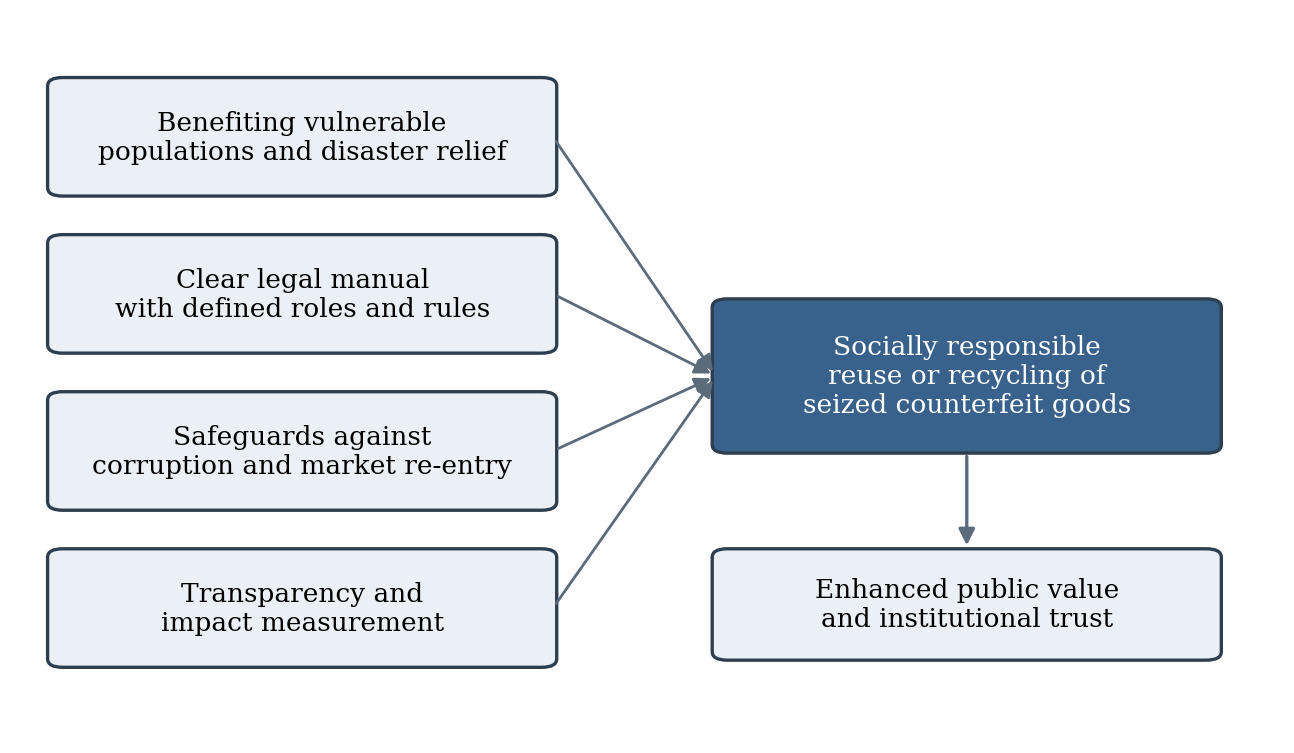
Seventy per cent supported recycling/reusing counterfeit goods for social causes, under strict conditions ensuring no misuse or market re-entry. Key criteria for reuse included:
-
benefits to vulnerable populations and disaster relief
-
the creation of a clear legal manual with responsibilities and rules
-
the prevention of corruption and misuse
-
transparency and impact measurement
-
promotion through the media to generate public awareness (Figure 2).

Some scepticism remained due to lack of current legal framework and brand owners’ concerns over reputation. As noted by one customs office, ‘brands prefer destruction to avoid damage to their image, but social reuse could generate jobs and reduce environmental harm if properly regulated.’ One of the lawyers also noted that ‘corruption risk exists, as seen in Colombia where donated goods were partially sold illegally.’
4.6 Influence of COVID-19 on intellectual property rights infringement
Half of the respondents believed the pandemic exacerbated counterfeit imports, especially health products like masks and vaccines, and increased online counterfeit sales. The other half argued counterfeit trade predated COVID-19. As noted by a SENADI representative, ‘IPR agency inspections and sanctions increased after the pandemic, with more counterfeit health items detected.’
4.7. Secondary data analysis
The secondary data corroborate the interview findings across three institutional sources: SENAE, specialised law firms and SENADI.
4.7.1. National Customs Service of Ecuador – intellectual property rights observations
According to official SENAE reports (SENAE, 2023), the number of IPR observations showed a significant increase in 2022 compared to 2021. In 2021, there were 19 observations, which rose sharply to 173 in 2022, an increase of 810 per cent. This surge coincides with the implementation of stricter legislation in August 2021 that strengthened the authority to control and sanction infringing goods.
Furthermore, data indicates that physical inspections of suspected infringing goods and the number of goods detained or separated also increased substantially. This trend reflects a stronger institutional commitment to early detection and rigorous enforcement in customs operations. Table 1 summarises the annual trend of IPR observations, physical inspections and detentions from 2020 to 2022.
More recent official reporting confirms that this upward enforcement trajectory has continued and, importantly, has begun to translate into measurable social value. Although SENAE has not published disaggregated counts of IPR observations, physical inspections and detentions for the 2023–2025 period, its aggregate interdiction and disposal indicators corroborate the trend. In 2024, SENAE seized goods valued at USD86.6 million, a 9 per cent increase over the USD77.7 million recorded in 2023, while the modernisation of scanning and digital risk-management systems raised total apprehensions by approximately 20 per cent (Solórzano, 2025). IPR-specific interdictions likewise persisted, exemplified by the June 2024 seizure of branded footwear misdeclared as fertiliser and the suspension of 179,490 units of counterfeit printer ink valued at close to USD2 million (SENAE, 2024). These figures indicate that counterfeit and infringing goods continue to reach Ecuadorian ports even as detection capacity strengthens.
4.7.2. Law firm legal protection actions
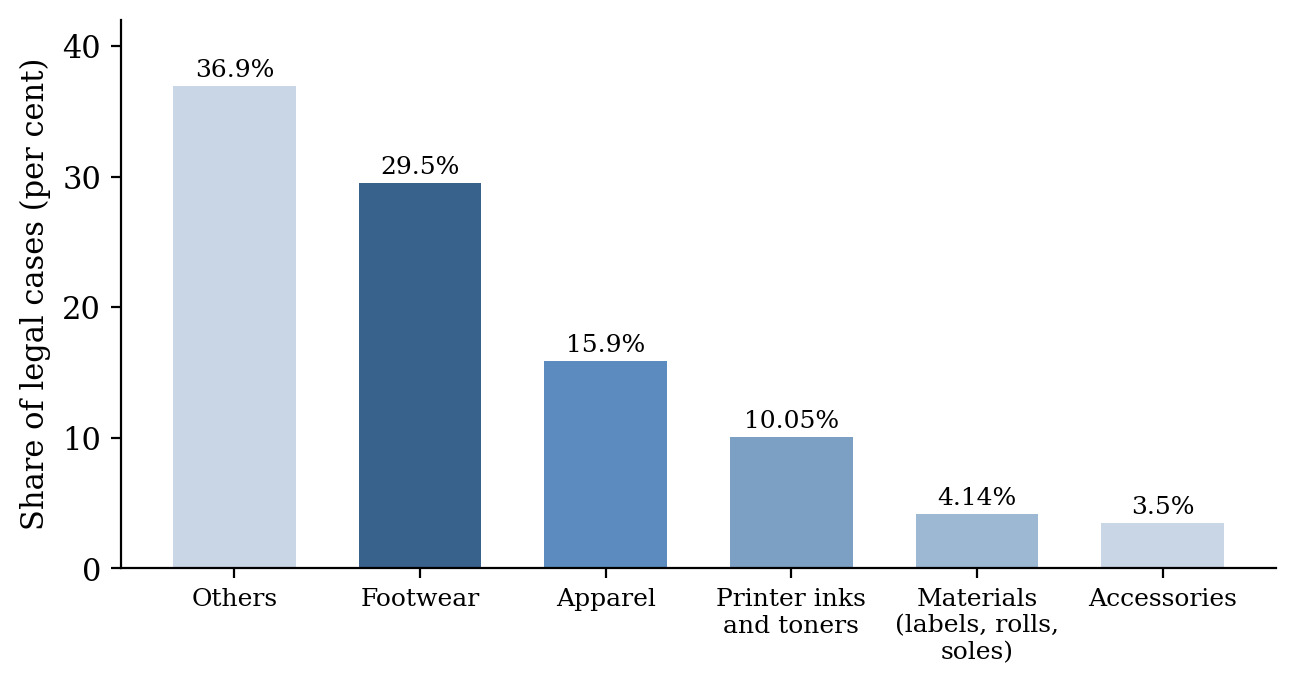
Data from law firms specialised in intellectual property protection show that approximately 67 per cent of legal actions taken between 2021 and 2023 were criminal proceedings, while the remainder were civil or administrative cases. The most commonly targeted counterfeit product categories in these legal cases are shown in Figure 3. The largest shares corresponded to unclassified ‘other’ goods (36.9 per cent) and footwear (29.5 per cent), followed by apparel (15.9 per cent), printer inks and toners (10.05 per cent), materials such as labels, fabric rolls and soles (4.14 per cent) and accessories (3.5 per cent).

Regarding the nature of legal actions, criminal cases predominated, resulting in confiscations, fines, and in some cases, preventive detention orders for offenders.
4.7.3. National Intellectual Rights Service protective measures
SENADI reported a notable increase in protective measures filed and sanctions imposed during 2022 and 2023. Most of these measures targeted school supplies – such as backpacks, notebooks and uniforms – especially during peak back-to-school seasons when demand spikes and the risk of counterfeit products rise. SENADI also indicated improvements in case monitoring and sanctions enforcement, with faster resolution times contributing to more effective deterrence against IPR violations. Table 2 summarises SENADI’s border enforcement and sanctioning activity for 2024–2025.
Official reporting for 2023–2025 confirms that SENADI’s enforcement has intensified markedly rather than stalled. Its Directorate of Observance – created in July 2023 – issued 243 observance resolutions in 2024, 21 per cent more than the 200 recorded in 2023, while the fines imposed on infringers rose steeply from USD648,960 in 2024 (a 92% increase over 2023) to USD1,212,466 in 2025. Border measures processed to suspend the import or export of goods suspected of infringing intellectual property likewise climbed from 107 in 2024 to 176 in 2025, with distinctive signs (trademarks) the most affected category (SENADI, 2024, 2025). These figures, summarised in Table 2, evidence a strengthening and increasingly systematic border-enforcement posture.
5. Discussion
This section synthesises the research findings to propose improvements in Ecuador’s customs policies related to IPR enforcement. It also discusses how public-private collaborations and ICT reforms can enhance social value and operational efficiency at SENAE. The discussion references existing academic literature to position the study’s contributions and to propose actionable reforms.
5.1. Public-private collaborations to enhance social value
The first research question explores how customs organisations can enhance social value via public-private collaborations. The findings clearly show that effective IPR protection in Ecuador requires a multi-stakeholder approach involving SENAE, SENADI and private law firms representing rights holders.
The study revealed three critical areas for collaborative intervention:
-
Legal reform and procedural manuals: All interviewees emphasised the need for comprehensive legal reform addressing gaps in customs operations related to IPR. SENADI and law firms must jointly develop a detailed manual specifying the responsibilities and procedures for handling IPR infringements. This manual would clarify sanctions, penalties and the treatment of seized counterfeit goods, including guidelines on possible reuse or recycling. Existing laws are fragmented, creating confusion and inefficiency in enforcement, which a coordinated legal framework can address.
-
Improved communication and information sharing: Poor coordination between SENAE, SENADI and law firms emerged as a major impediment. Although law firms and SENADI have relatively closer ties – sharing case statuses and trademark information – this information is rarely shared in a timely fashion with customs. Lack of strategic coordination results in duplicated efforts, missed inspections and ineffective enforcement. Establishing formal communication channels and real-time data sharing is essential to overcoming this fragmentation.
-
Joint training and capacity building: Collaboration with the private sector can also strengthen customs officers’ capacity through structured training programs. Currently, customs officers lack sufficient training in identifying counterfeit goods and managing enforcement procedures. Private law firms and SENADI could provide knowledge transfer, including on risk management, environmentally sustainable destruction and the social reuse of seized goods. This would build institutional expertise and reduce errors in detection.
These findings are well-supported by literature on public-private collaborations. Caldwell et al. (2017) argue that such collaborations can generate both social and commercial value. For Customs, this means not only protecting consumers and brands but also promoting fair trade and transparency. Law firms, by collaborating, can better protect their clients’ intellectual property while also contributing to social value initiatives such as reusing counterfeit goods to benefit vulnerable populations.
However, some of the literature also cautions that such collaborations require time, trust and effort to overcome inherent differences in goals and organisational cultures (Bayliss et al., 2004; Kivleniece & Quélin, 2011). In Ecuador, law firms expressed concern that collaborations might undermine the authority of public agencies, but also showed willingness to collaborate to improve enforcement results. Achieving a durable alliance will therefore require clear shared objectives, transparent roles and mutual benefits. The study thus highlights collaboration as a strategic enabler to overcome structural enforcement challenges, legal ambiguities, and gaps in officer training.
5.2. Information and communication technology-driven reforms for enhanced social value
The second research question investigates how ICT reforms could improve social value in customs’ IPR enforcement. The study found consensus among interviewees that automation and digital integration are urgently needed.
Two primary ICT reform strategies were proposed:
-
Automated trademark registration in customs IT systems: Currently, customs officers lack access to a centralised, updated database of registered trademarks, relying instead on SENADI’s separate system. This fragmentation makes it difficult to quickly identify counterfeit shipments. Approximately 60 per cent of respondents supported adding a trademark registration module directly into the customs IT system. This would allow brand owners to register their trademarks and legal representatives in a format accessible to customs officials, accompanied by manuals on distinguishing genuine from counterfeit products. Such automation would streamline inspections and reduce delays.
-
Improved communication and data sharing platforms: Inefficient communication between Customs, SENADI, law firms and rights holders currently hinders information flow, causing duplicated efforts and slower responses. An integrated communication system embedded within customs’ IT infrastructure could automate notifications, coordinate joint inspections and enable real-time data exchange. SENAE’s existing experience with single-route public sector communication suggests that such ICT reforms are feasible.
These findings echo the academic literature emphasising digital transformation’s role in improving government efficiency and social value delivery (Mahlunge, 2018; Nielsen & Jordanoski, 2020). Effective ICT reform supports transparent governance, enhances stakeholder trust and facilitates risk-based targeting – key for IPR enforcement. Customs could share risk assessment data with private partners, jointly enhancing the detection of counterfeit goods. Additionally, digital tools would improve customs’ customer service by protecting consumers and compliant importers and supporting law firms’ protection of intellectual property.
The study thus reinforces that public-private collaboration and ICT modernisation are interdependent. Digital platforms provide the infrastructure necessary for real-time collaboration, while collaborations provide the content and trust to sustain information sharing.
5.3. Feasibility of recycling and reusing seized counterfeit goods
The third research question explored the viability of reusing or recycling counterfeit goods to create social value. This proved to be a more contentious issue, with mixed perspectives from interviewees.
Regarding concerns and challenges, half of the respondents argued reuse is currently not feasible due to a lack of Ecuadorian legislation addressing the matter and the need to protect consumers and rights holders. There is fear that reused counterfeit goods could re-enter the market illegally, harming brand reputations and consumer trust. Brand owners invest heavily to protect their trademarks and are unlikely to approve reuse without robust safeguards.
Conversely, regarding support for social reuse, some respondents supported reuse or recycling if restricted to social causes, such as providing goods to vulnerable populations or disaster shelters. Clear guidelines, manuals, and monitoring would be essential to prevent misuse or unauthorised sales. Publicising such initiatives could enhance the reputations of customs and brand owners.
These findings align with research highlighting the complexity of counterfeit supply chains, especially as e-commerce platforms facilitate illicit trade (Allenbach-Ammann, 2022; Moberg & Pickard, 2020; Nikoofal et al., 2023). The study recognises that public-private collaboration is necessary to establish consensus and develop the legal frameworks needed to allow socially responsible reuse while protecting IPR.
International guidance from organisations like the OECD (2008) and the Anti-Counterfeiting Network Agency (REACT) supports prioritising reuse and recycling for social and environmental benefits (Brohm, 2018). Seized counterfeit goods, often composed of recyclable materials like plastic and metal, represent valuable resources that can be transformed into commercial or social goods, reducing waste and destruction costs.
This study contributes by highlighting that reuse/recycling could mitigate warehouse congestion, lower destruction expenses and generate social assistance for communities, fostering greater public awareness of anti-piracy laws. However, the key to success lies in clear legislation, transparent roles and rigorous oversight, requiring close cooperation among Customs, SENADI, law firms and rights holders.
Developments during 2023–2026 lend concrete empirical support to this argument and indicate that the trend is shifting from destruction towards socially oriented disposal. SENAE’s disposal of seized and abandoned goods, through free allocation to public and non-profit institutions or public online auction supervised by the Comptroller General of the State, expanded from roughly USD1.5 million donated nationally in 2023 to more than USD4.88 million adjudicated in 2024. Of this USD4.88 million, USD2 million was transferred to the Ministry of Economic and Social Inclusion, for distribution to vulnerable populations (SENAE, 2023, 2024; Solórzano, 2025). The pace has continued to accelerate at district level: in Guayaquil, the country’s principal port, free allocation rose from 32 in 2024 to 110 in 2025. This program has also measurably reduced the accumulation of deteriorating merchandise in customs warehouses, precisely the congestion that interviewees identified as a core operational problem.
These developments demonstrate that the institutional machinery, legal basis and political will for the socially oriented disposal of seized goods now exist within SENAE, and that greater social value is being created than in the period covered by the original fieldwork. Two caveats temper this optimism. First, the allocation and donation regime applies principally to legitimate contraband rather than to trademark-infringing goods, which, for reasons of consumer protection and brand integrity, generally remain subject to destruction; extending any form of reuse to counterfeit items would still require the dedicated legal safeguards, de-branding and oversight discussed above. Second, counterfeiting itself has not receded: infringing goods continue to be detected at the border, confirming that enforcement and socially responsible disposal must advance in parallel. The Ecuadorian experience thus increasingly mirrors the international guidance favouring reuse and recycling for social and environmental benefit, while illustrating that the decisive variable remains a clear, well-governed legal framework co-produced by customs, SENADI, law firms and rights holders.
6. Conclusion
This article contributes to the understanding of social value creation in the public sector through public-private collaboration and ICT-driven reforms, focusing on the National Customs Service of Ecuador’s (SENAI) enforcement of IPR. The study offers an empirical foundation addressing how customs agencies can improve their operations by involving private sector actors and adopting digital technologies.
A key theoretical contribution is the nuanced understanding of public-private collaborations within Customs. The research highlights that collaborations vary by the number and type of actors involved, the degree of profit-seeking behaviour from private firms, and the necessity of mutual trust and flexible mindsets in public agencies. Specifically, more of the actors involved require stronger coordination and information sharing, higher profit-seeking behaviour by private firms demands clearer regulations, and public agencies must foster trust and flexibility to sustain collaboration.
These propositions extend current public management and hybrid governance literature by emphasising how different collaboration contexts shape outcomes and governance needs, a topic underexplored in prior studies.
The research also offers a comprehensive overview of the current IPR enforcement landscape in Ecuador, revealing both strengths and challenges. Customs officers show strong awareness of IPR significance, recognising the importance of border enforcement.
Critical gaps remain in customs policies, including inadequate collaboration between customs, the National Intellectual Rights Service (SENADI) and private law firms, the absence of clear procedures, manuals and legal frameworks specific to IPR enforcement, and a lack of automation in trademark registration processes. It also includes insufficient and inconsistent training for customs officers at key border points. Finally, these weaknesses hamper the effective detection and control of counterfeit goods, which threatens consumers, legitimate businesses and the country’s trade reputation.
Improved collaboration between public agencies and private stakeholders emerges as essential to advancing IPR protection. To address the absence of a centralised trademark database, Customs must collaborate closely with SENADI and law firms to develop an automated registration and information-sharing platform. Financial constraints limit Customs’ ability to train frontline officers, highlighting the need for collaborative training programs with private experts.
Diverse reporting methods and the lack of standardised enforcement procedures point to the necessity of establishing clear, coordinated protocols across agencies. Lessons from Japanese Customs showcase how integrated public-private efforts can enhance IPR enforcement, suggesting that Ecuador could benefit from adopting similar collaborative models. This collaboration promises not only improved enforcement outcomes but also enhanced social and commercial value by protecting consumers and intellectual property holders alike.
Automation and ICT modernisation are vital levers to overcome current inefficiencies.: The absence of a customs-owned trademark database impedes timely recognition of counterfeit goods. Establishing a centralised automated brand registration system would streamline the process for rights holders, enabling customs officers to access comprehensive, up-to-date trademark information. Such a system could incorporate notification alerts on suspicious consignments, linked with customs’ risk management tools to prioritise inspections effectively. Improving communication channels between customs, SENADI, law firms and rights holders via integrated digital platforms would reduce duplicated efforts, accelerate information sharing, and enhance transparency.
These reforms align with global trends emphasising digital governance to deliver customer-oriented public services, fostering trust and compliance. The study underlines that ICT reforms are not stand-alone but must be embedded within collaborative frameworks to maximise their social and operational impact.
Based on the findings, the article proposes the following practical steps for SENAE to strengthen IPR enforcement:
-
Enhance cooperation with rights holders: Establish designated contact points in each customs regional office to facilitate ongoing communication and joint initiatives, such as product identification training and public awareness campaigns, and launch a dedicated online platform for IPR news, procedures, and seizure announcements to increase transparency and stakeholder engagement.
-
Legal framework reform: Revise customs laws to align with international standards (e.g. TRIPS), clarifying border enforcement measures and procedures, and develop comprehensive manuals detailing roles, inspection procedures, detention protocols and guidelines for handling seized counterfeit goods, including potential reuse or recycling.
-
Automated brand registration: Create a centralised, automated trademark registration module accessible to customs officers nationwide, integrate this system with customs’ risk management to enable real-time alerts and efficient inspection targeting, and decentralise initial registration checks to regional IPR units with final approval managed centrally, balancing efficiency and control.
-
Specialised IPR units at border stations: Allocate resources to establish specialised customs units dedicated to IPR enforcement at key ports and border points, foster collaboration with SENADI, law enforcement, prosecutors and law firms to streamline case management and enforcement actions, and consider launching informational websites mirroring Japanese Customs’ approach to provide guidance, application processes and public seizure records.
-
Institutionalise the social disposal of seized goods: Building on the allocation and donation regime that SENAE consolidated in 2024, develop a dedicated legal and procedural framework for the socially responsible disposal of seized goods, including – under strict safeguards, de-branding and independent oversight – the recycling or social reuse of appropriate categories of seized merchandise. Formalising this pathway would reduce warehouse congestion and destruction costs while converting enforcement into tangible public value, in coordination with the Ministerio de Inclusión Económica y Social (Ministry of Economic and Social Inclusion), SENADI and rights holders (SENAE, 2024).
The study acknowledges limitations such as the small qualitative sample size, which restricts generalisability, and the lack of quantitative data, which could provide deeper insights into enforcement outcomes.
Future research is encouraged to explore other facets of IPR enforcement in Ecuador, especially copyright and related rights, gather extensive data from multiple stakeholders, including SENADI, law enforcement, and customs officers across regions, examine risk management practices in customs, particularly the emerging role of artificial intelligence in targeting and border protection and finally, to compare IPR enforcement frameworks across countries to identify best practices and context-specific adaptations.
A further limitation concerns data availability: whereas the primary fieldwork drew on internal institutional records, publicly disaggregated statistics on IPR observations, inspections and SENADI sanctions were not available for the 2023–2025 period, so the most recent trends reported here rely on aggregate and qualitative official sources. Future research should therefore pursue longitudinal, disaggregated datasets and in particular, evaluate the social value outcomes of SENAE’s emerging allocation and donation regime – quantifying its beneficiaries, cost savings and deterrent effects – to test whether socially oriented disposal can be safely and effectively extended to counterfeit goods.
Disclosure on the use of generative artificial intelligence
In preparing this manuscript, the author used Claude (Opus 4.8; Anthropic) to assist with language editing and with formatting the manuscript to the journal’s style requirements. The tool was not used to generate the research design, data collection, analysis or interpretation, which are the author’s own work. The author reviewed and verified all information, data and citations, and takes full responsibility for the content of this article.